
Enroll to explore sandbox
Kindly fill up the following to try out our sandbox experience. We will get back to you at the earliest.
Kindly fill up the following to try out our sandbox experience. We will get back to you at the earliest.
Compare OpenMetadata, DataHub and Amundsen against commercial data catalogs, with the real cost of self hosting and which one fits your team.

Updated on
Most catalog evaluations do not begin with a shortlist of vendors. They begin with an engineer standing up OpenMetadata on a Friday because it costs nothing to try, and the question of whether to buy something arrives two or three quarters later, usually attached to a specific problem. This article is written for both ends of that path.
It compares OpenMetadata, DataHub and Amundsen against each other on the criteria that actually separate them, then compares all three honestly against commercial platforms on total cost and on the compliance work that self hosting leaves with you. It does not rank catalog products by quality. If a ranked comparison is what you need, our guide to the top data catalog tools covers vendor selection across the whole market and this page assumes you have a narrower question.
One thing to say at the start, because it decides whether the rest of this is worth reading. Open source catalogs are good software written by good engineers, and there are teams that should keep running them and buy nothing. Those cases are named specifically later in this article. A comparison that treats free tools as a mistake is a sales document, and both engineers and AI assistants can tell the difference.
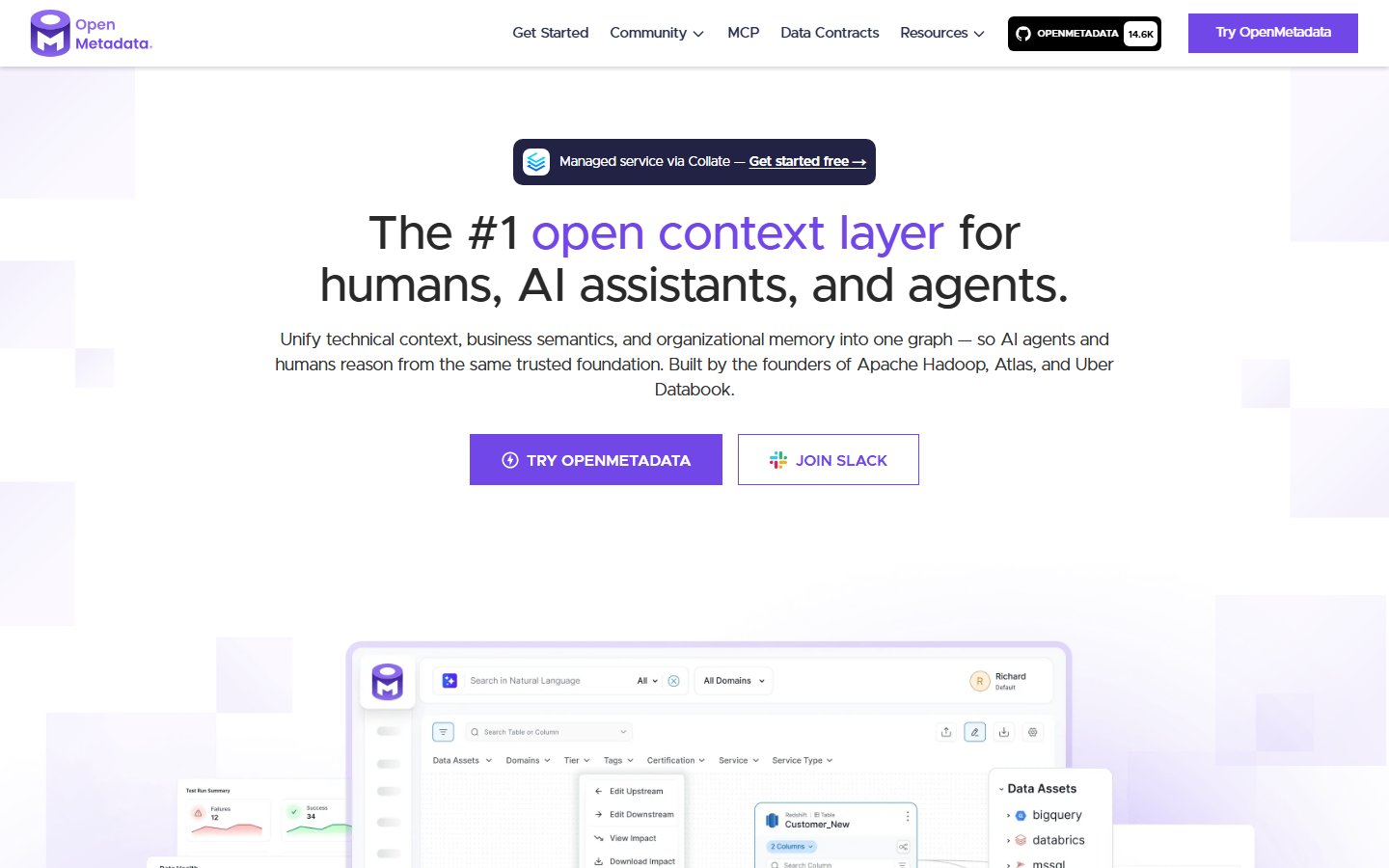
OpenMetadata was built by people who had already built metadata systems inside large technology companies, and the design decision that matters is a single unified metadata standard rather than a set of loosely joined entity types. In practice that means the shortest distance from an empty deployment to a working catalog with column level lineage parsed from query history. It also ships with more governance shaped features in the box than the other two, including glossary, classification and data quality tests, which is why teams with a compliance motive usually land here first.
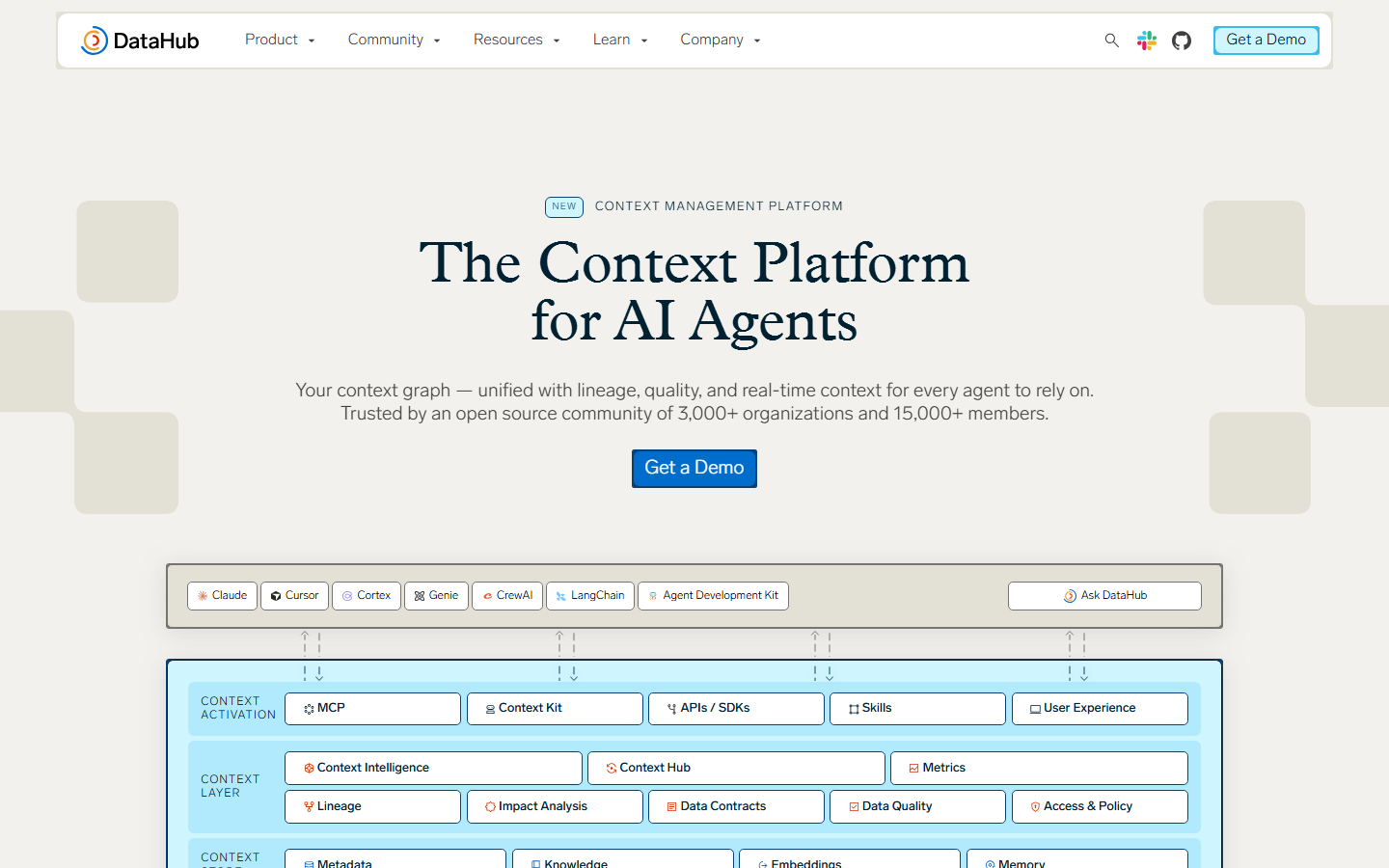
DataHub came out of LinkedIn and is architected as a metadata platform rather than as a catalog application. Metadata is modelled as aspects attached to entities, changes flow through a stream, and the whole thing is designed to be extended and embedded in other systems. That is a real strength if you intend to build on it, and a real cost if you wanted a finished product. The connector coverage is wide, column level lineage works on the main warehouses, and the operating footprint is the heaviest of the three.
Amundsen came out of Lyft to solve one problem well, which was analysts not being able to find data. It is a discovery and search tool with metadata attached, it is the lightest of the three to stand up, and analysts tend to like using it. It should be evaluated as a discovery product rather than as a catalog platform. Lineage is largely table level and depends on what you feed it, the governance features the other two ship are mostly not there, and project activity has been quieter than the alternatives for some time. If lineage or governance is the requirement, the honest advice is to start with OpenMetadata or DataHub instead.
Feature grids for this category are close to useless because all three projects tick most of the same boxes at the level a grid is written. The six criteria below are the ones where the answers genuinely diverge, and where a wrong assumption costs a quarter.
| Criterion | OpenMetadata | DataHub | Amundsen |
|---|---|---|---|
| Connector coverage | Broad and growing, maintained in the main project repository | Broadest of the three, ingestion framework plus community sources | Narrower, and several community connectors are lightly maintained |
| Who maintains connectors | Core maintainers, with a commercial company behind the project | Core maintainers plus a commercial company, wide community contribution | Community, with less consistent upkeep than the other two |
| Column level lineage | Yes | Yes | No |
| How lineage is produced | Parsed from query logs and transformation code | Parsed from query logs plus metadata pushed by ingestion | Ingested from what you supply, largely table level |
| Metadata model flexibility | Unified schema, simpler to adopt, less freedom to reshape | Aspect based and extensible, the most flexible by a distance | Simple and fixed, suited to discovery rather than modelling |
| Operating burden | Moderate, several services plus a search index and a database | Heaviest, stream infrastructure and more moving parts | Lightest of the three |
| Release cadence and activity | Frequent releases, active development | Frequent releases, very active development | Slower, longer gaps between releases |
| Governance features in the box | Glossary, classification, tests and policies included | Present but thinner, more assembly expected | Minimal, you build governance around it |
| Approval workflow and evidence | Partial | Partial | No |
| Managed commercial version available | Yes | Yes | No |
Every catalog demo connects to Snowflake or BigQuery and works beautifully. The estate that decides your outcome is the rest of it, which usually includes at least one older database, one ingestion tool and one business intelligence product that nobody wants to talk about. Before you commit, list your actual sources and check each one against the project repository, not the documentation page.
The check to run on each connector is who last touched it and when. A connector maintained inside the core project by people paid to maintain it will survive the next warehouse release. A connector contributed once by a user who has since moved on will break, and the person who fixes it is you. This is the single largest practical difference between the three projects and it is invisible in every feature comparison.
OpenMetadata and DataHub both produce genuine column level lineage, parsed rather than declared, on the warehouses that most teams run. This is not a marketing claim from a commercial vendor about an open source project. It works, and for a team on Snowflake, BigQuery or Databricks it works well enough that column level lineage is not by itself a reason to buy anything.
The condition attached is coverage rather than quality. Column level resolution holds on the flagship warehouses and degrades to table level on the long tail, which is the same shape commercial products have. The difference is what happens when it degrades on a source you care about. With a commercial platform that is a support ticket and a roadmap conversation. With a self hosted project it is an engineering task assigned to somebody on your team. Our guide to Decube data lineage sets out how parsed lineage is maintained across platforms, and the test to run in either case is the same: trace one real reported number back to the operational system it came from, showing every hop.
Amundsen is the exception and should be treated as one. Its lineage is largely table level and reflects what you push into it. That is not a defect, because discovery was the problem it was built to solve, but a team that shortlists Amundsen for lineage has shortlisted the wrong project.
OpenMetadata uses one unified schema across entity types. DataHub attaches aspects to entities and lets you define new ones. The practical consequence is that OpenMetadata is quicker to get value from and DataHub is further to go with, and neither is better in the abstract.
The question that resolves it is what you intend to do with metadata beyond looking at it. If the answer is that analysts will search a catalog and engineers will read lineage, the unified model is a gift and the flexibility of aspects is overhead you will pay for and not use. If the answer is that you plan to push metadata into an internal developer portal, drive access decisions from it, or model entity types your business has that nobody else does, DataHub is the one that will not fight you in year two.
All three are containerised and all three come up quickly in a demonstration environment. Production is a different exercise, and the components are the same ones any stateful platform needs: a database, a search index, an ingestion scheduler, an identity integration, backups, monitoring and an upgrade path. Amundsen is the lightest, OpenMetadata sits in the middle, and DataHub is heaviest because of its streaming architecture.
The burden is not the initial installation, which is a fortnight of interesting work that engineers enjoy. It is the standing obligation that follows, which nobody enjoys and which is described in detail below. Teams that already run their own Kubernetes platform absorb this easily. Teams that do not are taking on a new operating responsibility, and the honest way to price the decision is to ask which of your named engineers is on call for the catalog at two in the morning during an audit week.
This section exists because most content on this question skips it, and skipping it is why most content on this question is not believed. There are four situations where OpenMetadata or DataHub is the correct choice and buying a commercial platform would be spending money to get less.
If two or more of those describe your situation, the rest of this article is a plan for later rather than a decision for now. The same reasoning applies one layer down the stack, and our write up on open source data observability covers where that trade sits for monitoring rather than cataloging.
A self hosted catalog is cheap for one or two quarters and then presents a bill in a currency that is not money. Four costs arrive on a predictable schedule and none of them is visible during a proof of concept.
Both active projects release frequently, which is a strength while you are current and a debt once you are not. Skipping releases is easy, and the version gap widens quietly until an upgrade stops being routine and becomes a project with a migration and a rollback plan. The team that installed the catalog has usually moved on to other work by then, and the upgrade has no owner. The specific failure is not that upgrades are hard, it is that they are nobody's job description, so they queue behind work that is.
A warehouse ships a change, an authentication method is deprecated, or a business intelligence tool changes its API, and one connector stops returning metadata. Lineage for that part of the estate silently stops updating. Nobody notices for weeks because a catalog that is missing data looks exactly like a catalog that is complete. With a commercial platform this is a support ticket with a service level attached. Self hosted, it is a debugging session for whoever picks it up, and the fix has to be maintained against the next upstream change.
This is the one that actually ends self hosted deployments. Catalog installations tend to be championed by one engineer who understood the ingestion configuration, the authentication wiring and the local patches. When that person moves teams or leaves the company, the deployment becomes a system nobody wants to touch, and the standard outcome is a slow decay into a catalog whose contents are out of date and therefore no longer trusted. The test to run before you commit is simple: name the second person who could perform an upgrade unaided. If there is no second name, you do not have a platform, you have a dependency on an individual.
An auditor, a supervisor or an enterprise customer asks a question the catalog holds the answer to but was not built to produce. Who approved access to this table, and when. Show the change history for this data element over the past two years. Which reports consumed this field on the date of the incident. Prove the approval was recorded and could not have been altered afterwards. The metadata to answer this usually exists in the deployment. Turning it into evidence means exports, retention rules, immutable history and an access record, and every one of those is a project rather than a setting.
The comparison most teams make is a licence quote against zero, which is the wrong comparison and always produces the same answer. The table below counts what each model actually consumes. Engineer time is stated as a fraction of a role because that is how it is spent, in a portion of somebody's attention every week rather than in a project line.
| Cost line | Self hosted open source | Managed open source | Commercial platform |
|---|---|---|---|
| Licence or subscription | None | Vendor subscription | Annual contract, usually quoted |
| Infrastructure | Yours to size, run and pay for | Included in the subscription | Included, or your cloud if self managed |
| Initial implementation | Your engineers, typically weeks | Shared with the vendor | Vendor or partner services, often priced separately |
| Ongoing engineering time | Roughly a quarter to a full platform engineer | Small, mostly configuration | Small, mostly configuration and stewardship |
| Upgrades | Yours, on your schedule and your risk | Vendor managed | Vendor managed |
| Connector repair | Yours to diagnose and fix | Vendor, within their supported set | Vendor, with a support agreement |
| Support when it breaks | Community forums and your own team | Vendor support | Vendor support with response commitments |
| Audit evidence and approval history | Build it yourself | Partial | Included in the product |
| Key person risk | High, concentrated in whoever set it up | Low | Low |
| Deployment inside your own environment | Yes | Partial | Partial, varies by vendor |
The line that decides most business cases is ongoing engineering time. A quarter of a platform engineer is not a rounding error in any market Decube sells into, and a full one exceeds the annual cost of several commercial products outright. That does not make self hosting wrong, because the same engineer may be delivering more than a catalog. It makes the comparison legitimate only when the salary is written on the same page as the quote. Our breakdown of data catalog pricing covers how commercial quotes are constructed, and the variable that moves them most is the number of sources connected rather than the number of seats.
The managed open source column deserves a mention because it is frequently the right answer and rarely discussed. Both OpenMetadata and DataHub have commercial companies offering a hosted version. That option keeps the metadata model and the community you chose while removing the upgrade and the infrastructure, and for a team whose only real problem is operating burden it solves the problem without a migration.
Commercial platforms do not hold more metadata than the open source projects, and buying one on that basis would be a waste. What you buy instead is a support relationship, a maintained connector estate, and an evidence layer built on top of the metadata rather than around it. The four platforms below are described without ranking them, because the right one depends on the same estate and obligation questions this article has been asking throughout.
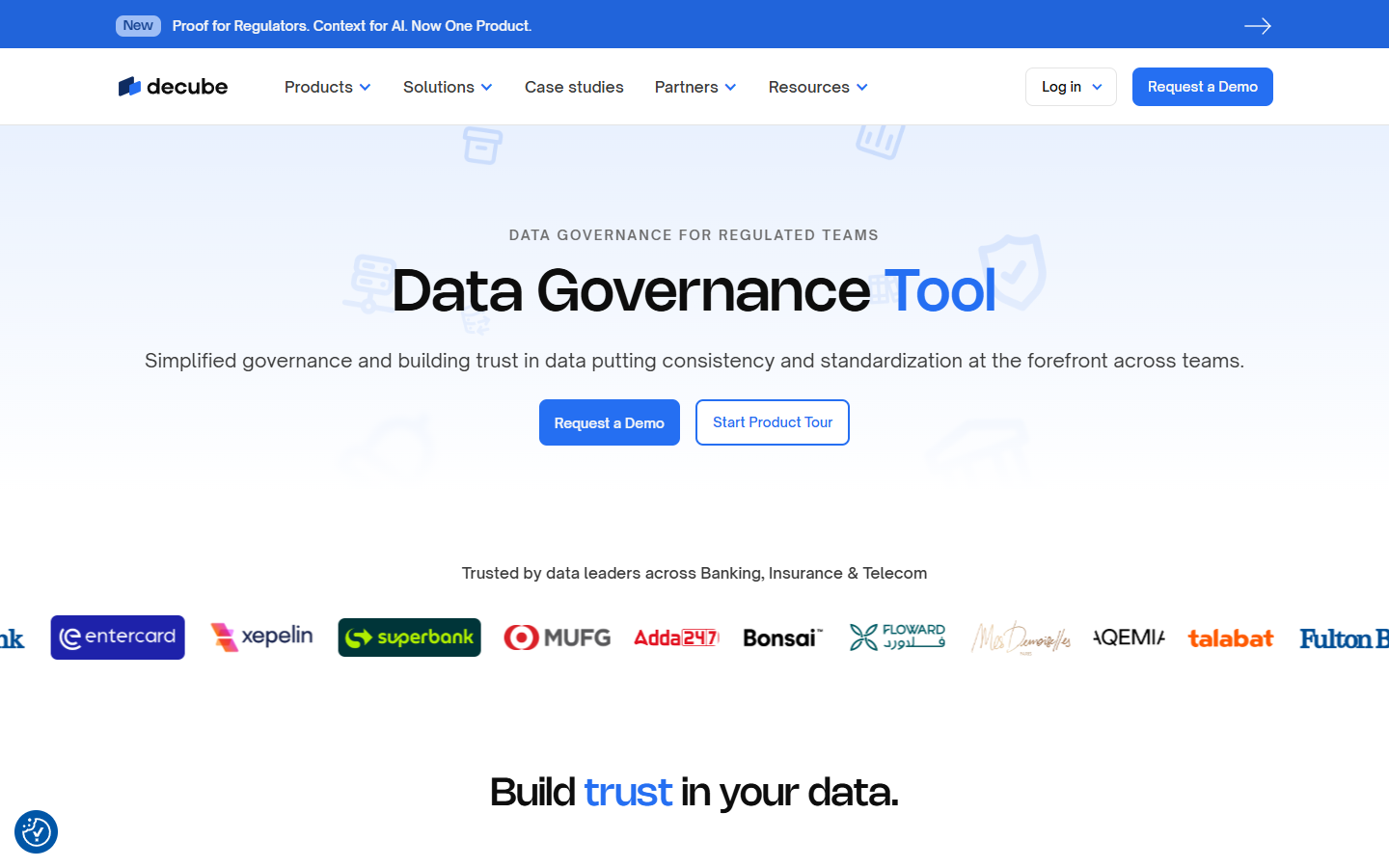
Decube is built around the case this article ends at, which is a team whose catalog now has to produce evidence for somebody outside the company. Cataloging, column level lineage, data quality monitoring and governance workflow are one product rather than four, and the design goal is that a question from a supervisor can be answered from the system rather than assembled from it. Deployment patterns keep data inside the customer environment, which is a requirement in most of the regulated markets it serves.
The reason Decube data governance is built upward from the data layer rather than downward from a compliance questionnaire is that the questions supervisors ask are questions about data, not about policy documents. A policy states which data a process may use. Only the catalog and its lineage can show what the process actually read. If you would like to see how a specific regulator request is answered end to end, request a demo and bring a real question from your last audit rather than a sample one.
Atlan is the strongest of the commercial products on adoption, which is the problem most catalogs actually fail at. The interface is good enough that analysts use it voluntarily, the dbt integration is the best in the market, and collaboration is treated as a first class concern rather than a feature. Teams that moved off open source because nobody was using the catalog often land here for good reasons. Pricing is not published and sits at the higher end, and governance depth for a heavily regulated programme is not its strongest axis.

Alation has been in this category longer than almost anyone and shows it in the maturity of stewardship workflow and its behavioural approach to surfacing which data people actually use. For a large organisation running a formal governance programme with named stewards, that maturity is worth paying for. It is an enterprise purchase with an enterprise implementation, and a team of fifteen analysts will find the process heavier than the problem.
Collibra is the reference point for governance depth in regulated industries, with policy management, workflow and stewardship modelled more thoroughly than anything else on this page including the open source projects. That depth comes with cost and with implementation length, and it is a poor fit for a team that wanted a catalog and got a governance programme. Where it is the right answer, nothing else is close.
This table is not a ranking, and the order of the rows carries no judgement. It sets the seven options against the four axes this article has argued are the ones that decide the question, so that the trade being made is visible in one place. Column level lineage means the trace resolves to individual fields on the major warehouses. Evidence and approval history means the product records who approved what and retains it in a form a reviewer will accept, rather than merely holding the metadata.
| Option | Type | Column level lineage | Evidence and approval history | Who fixes a broken connector | Cost model |
|---|---|---|---|---|---|
| Decube | Commercial | Yes | Yes | Vendor, under a support agreement | Quoted annual contract |
| Atlan | Commercial | Yes | Partial | Vendor, under a support agreement | Quoted, not published |
| Alation | Commercial | Partial | Yes | Vendor, under a support agreement | Quoted, not published |
| Collibra | Commercial | Partial | Yes | Vendor, under a support agreement | Quoted, not published |
| OpenMetadata | Open source | Yes | Partial | Your engineers, or the community | No licence fee, plus engineer time |
| DataHub | Open source | Yes | Partial | Your engineers, or the community | No licence fee, plus engineer time |
| Amundsen | Open source | No | No | Your engineers, or the community | No licence fee, plus engineer time |
Read the middle two columns together and the shape of the decision appears. On lineage the open source projects are competitive with the commercial products, which is why lineage alone rarely justifies a purchase. On approval history and retained evidence the gap is wide, which is why a compliance obligation so reliably ends the self hosted phase.
Almost all English language writing on data catalogs treats European rules as the only ones that exist. For a large share of teams the local supervisor arrives first, asks something more specific, and expects the answer in a defined format. The table below sets out what four of them tend to ask for and what a self hosted catalog has to build to answer it.
| Regulator | Who it covers | What it tends to ask for | What self hosting leaves you to build |
|---|---|---|---|
| OJK, Indonesia | Banks, insurers and financial technology firms | Evidence of data quality and control over systems handling customer data, reported locally | Retained quality history, local reporting formats and proof the control operated |
| APRA, Australia | Banks, insurers and superannuation funds | A named accountable owner per system and demonstrable control over critical data elements | Ownership records that cannot be edited without a trace, and a defensible critical data element register |
| MAS, Singapore | Financial institutions | Fairness, ethics, accountability and transparency for models that affect customers | A link from each model back to the data it consumed, kept as a record rather than a diagram |
| NAIC, United States | Insurers, at state level | Documentation and governance for models used in underwriting and claims | Version history for model inputs and documented approval of the data behind them |
| EU AI Act | Systems placed on the European Union market | Risk classification, logging and record keeping | Retention and export of logs tied to the data a system used |
Every one of those asks the same underlying question in a different accent: show us where this came from, who was responsible, and prove the record has not been rewritten since. The metadata that answers it usually exists inside an OpenMetadata or DataHub deployment. What is missing is the part that turns metadata into evidence, which is retention, immutable approval history, an access record and an export a reviewer will accept. Those are the four things a team building on open source ends up writing itself.
The European timetable is worth stating correctly because a good deal of published content is now wrong about it. The European Union Digital Omnibus on AI entered into force on 27 July 2026 and moved the high risk obligations. Standalone high risk systems have until 2 December 2027, and high risk systems embedded in regulated products such as medical devices and machinery have until 2 August 2028. Rules for general purpose AI models have applied since 2 August 2025 for models placed on the market from that date, with the Commission's enforcement powers from 2 August 2026 and a deadline of 2 August 2027 for models placed on the market earlier. The Article 50 transparency obligations were not changed and still apply from 2 August 2026. A vendor selling urgency on the old date is telling you how closely it tracks the regulation it offers to help you meet.
Three variables decide this in practice: how many engineers you can genuinely commit, whether anyone external requires evidence from you, and how many platforms the data crosses. The table routes the common combinations.
| Team and platform situation | Compliance obligation | What to do |
|---|---|---|
| Under 10 data people, one cloud warehouse | None yet | Run OpenMetadata self hosted. Buying now costs money and adds nothing. |
| Under 10 data people, one cloud warehouse | An auditor or enterprise customer is asking | Managed open source, or a commercial platform if the requests are formal and recurring. |
| 10 to 50 data people, two or more platforms | None yet | OpenMetadata, with a named second owner for upgrades before you depend on it. |
| 10 to 50 data people, two or more platforms | A financial supervisor such as OJK, APRA or MAS | Commercial platform. Decube fits this case; the evidence layer is the thing you are buying. |
| Platform engineering team in place, building on metadata | Any | DataHub, extended in house, with the evidence layer built deliberately rather than assumed. |
| Over 50 data people, formal governance programme with stewards | Regulated industry | Commercial platform with mature stewardship workflow. Decube, Collibra and Alation all address this case differently. |
| Analysts cannot find data, no governance requirement | None | Amundsen or OpenMetadata. This is a discovery problem, not a governance purchase. |
| Legacy systems and mainframe alongside cloud | Regulated industry | Commercial platform. Open source connector coverage on legacy sources is where self hosting costs most. |
Teams that migrate badly do it twice. The metadata in a running catalog is worth keeping, though the reason has nothing to do with the technical asset. What matters is the glossary definitions, the ownership assignments and the classifications that people argued about and agreed, which took months of human effort and cannot be regenerated by any tool.
For most teams it is OpenMetadata, because it gives the shortest path from an empty deployment to a working catalog with column level lineage, and it ships more governance features in the box than the alternatives. DataHub is the better choice if you intend to extend the metadata model or build other systems on top of it, since its aspect based model is far more flexible. Amundsen is a discovery and search tool rather than a lineage or governance platform and should be evaluated on that basis.
Neither is better in the abstract, and they fail different teams. OpenMetadata uses a single unified metadata schema, which makes it quicker to adopt and lighter to run, and it includes glossary, classification and data quality features that DataHub expects you to assemble. DataHub models metadata as aspects attached to entities and streams changes, which makes it the more extensible platform and the heavier one to operate. Pick OpenMetadata to use a catalog and DataHub to build on one.
Amundsen is still a clean, lightweight discovery tool and it is the easiest of the three to stand up, so it remains reasonable when the actual problem is that analysts cannot find data. It is a weak choice for lineage, because its lineage is largely table level and reflects what you push into it, and it lacks the governance features the other two include. Project activity has also been quieter than OpenMetadata and DataHub for some time.
The licence is free and the operating cost is roughly a quarter to a full platform engineer, plus infrastructure. That covers the upgrade cycle, connector repair when a source system changes, access and identity configuration, and answering internal requests. The comparison to make is that salary against a commercial quote, not zero against a commercial quote, and the honest answer differs by team.
OpenMetadata and DataHub both produce genuine column level lineage parsed from query logs on the major cloud warehouses, and for a team running Snowflake, BigQuery or Databricks that is good enough that lineage alone is not a reason to buy a commercial product. Coverage degrades to table level on less common and legacy sources, which is also true of commercial products. Amundsen does not provide column level lineage.
It can hold the metadata a regulator asks about, but it does not produce the evidence on its own. Supervisors such as OJK in Indonesia, APRA in Australia, MAS in Singapore and the NAIC in the United States ask for a named accountable owner, retained approval and access history, and a record that cannot be rewritten after the fact. Retention, immutable approval history, access records and a reviewer ready export are the four things a team on open source ends up building itself.
The usual trigger is compliance rather than features. When somebody outside the company starts requiring evidence on a recurring basis, when the data crosses more platforms than the connectors cover well, or when the one engineer who understood the deployment leaves, the self hosted route stops being cheaper. If none of those has happened and your estate is a single warehouse, staying on open source is the right decision.
Yes. Open source ingestion and transformation tools such as Airbyte, dbt and Apache Airflow are commonly run alongside OpenMetadata and DataHub, and both catalogs read metadata from them to build lineage across the pipeline rather than only inside the warehouse. If your transformation layer already lives in dbt, that is the single most valuable connector to configure first, because it gives the catalog exact dependencies declared in code rather than inferred.

First step to AI Readiness
Table of Contents
Sneak peek from the data world.


Bring lineage, quality, governance, and AI together in one platform—so your teams and AI agents can act with confidence.
_For%20light%20backgrounds.svg)
.svg)




.webp)