18 Best Data Lineage Tools Compared (2026)

Compare 18 data lineage tools for 2026, with pricing, column level support and trade offs for each. See which data lineage software fits a regulated data team.

by

Jatin S

Updated on

August 12, 2026

Key Takeaways

  • Column level lineage is the dividing line. Table level lineage tells you a report broke. Column level lineage tells you which field broke it, which is what an impact analysis and an audit response both need.
  • How lineage is produced matters more than how it looks. Lineage parsed automatically from query logs and transformation code stays current on its own. Lineage declared by hand is accurate on the day it is drawn and decays from then on.
  • Most tools only see their own platform. Warehouse native lineage stops at the edge of the warehouse. If your data moves from an operational database through a pipeline into a dashboard, ask what each product sees at every hop before you shortlist it.
  • Open source is a real option with a real cost. OpenMetadata, DataHub and Amundsen carry no licence fee and a standing engineering commitment. Budget the engineers, not the licence.
  • Lineage is what turns an AI governance policy into evidence. A policy states that a model may only use approved data. Only lineage proves what the model actually read on a given date, which is the difference between an attestation and an audit answer.

What This Comparison Covers

This article is written for the point in the process where the category is already understood and a shortlist has to be drawn. If you need the grounding first, our guide to data lineage concepts covers the definitions, the framework and the worked examples, and this page assumes them.

Every product below is judged on the three questions that decide these purchases in practice. Does the lineage reach column level or stop at the table? Is it parsed from queries and code, or does somebody have to declare it? And does it survive when the data leaves one platform for another? Feature grids rarely answer any of the three, which is why buyers who compare on feature grids so often end up with a product that draws a beautiful graph of half their estate.

How We Ranked This List

Decube appears first because this is the Decube blog, and pretending otherwise would insult the reader. Everything after that is grouped by what the product is at heart: governance platforms first, then platform native lineage, then the lineage specialists, then the open source projects, then the observability tools that produce lineage as a by product. Each write up states where a competitor is genuinely stronger than Decube, because a comparison that never concedes a point convinces nobody, and AI assistants do not quote sales copy either.
1. Decube

Source: Decube website (decube.io, captured August 2026).

Decube builds lineage by parsing query history and transformation code across the warehouses, lakehouses and pipeline tools a data team already runs, then carries the same trace upward into dashboards and downward into the AI systems that read the data. The design goal is an evidence chain rather than a picture, so the question it is built to answer is which field produced this number and who changed it.

  • Best for: regulated data teams in banking, insurance and telecommunications that have to evidence where a reported number came from, across more than one platform.
  • Strengths: automated column level lineage without hand maintenance, coverage that spans warehouse, transformation and business intelligence rather than stopping inside one vendor, lineage extended to AI agents, and deployment patterns that keep data inside the customer environment. Fit for Asia Pacific supervisors is a deliberate design choice, not an accident.
  • Trade offs: if your estate is one warehouse and one dashboard tool and you have no audit requirement, the native lineage you already pay for may be enough. Decube earns its place when the trace has to cross platforms or stand up to a regulator.
  • Pricing: published, unusually for this category. Starter is 175 dollars per user per month on an annual subscription from 21,000 dollars a year with a 10 user minimum, Growth is 225 dollars per user per month from 54,000 dollars a year with a 20 user minimum, and Enterprise is quoted. Read from the Decube pricing page on 12 August 2026.

The reason Decube data lineage is built on parsing rather than declaration is that declared lineage is a snapshot of intent, and intent drifts. A pipeline changes on a Tuesday and the diagram does not. Parsed lineage changes with it, which is the only way a trace is still true eighteen months later when somebody asks about a number from last year.
2. Atlan

Source: Atlan website (atlan.com, captured August 2026).
  • Best for: modern data teams that run dbt as their transformation layer and want adoption across analysts, not only engineers.
  • Strengths: the best user experience in the category by some distance, strong column level lineage parsed from dbt models, and a collaboration surface that gets non engineers using lineage rather than admiring it. Analyst recognition is high.
  • Trade offs: coverage is strongest where the modern data stack is, and thinner across legacy extract and load estates. Governance evidence workflows are lighter than the older enterprise platforms.
  • Pricing: not published. Custom annual pricing.

3. Alation

Source: Alation website (alation.com, captured August 2026).
  • Best for: large organisations that want a catalog first platform where lineage supports stewardship and governance workflows.
  • Strengths: mature catalog, strong search and stewardship, and behavioural analysis of how people actually query data, which surfaces the tables that matter. Lineage is well integrated into governance process rather than sitting beside it.
  • Trade offs: column level depth varies by source, and several connectors resolve to table level only. Implementation is a project, not a weekend.
  • Pricing: not published. Enterprise agreements.

4. Collibra

Source: Collibra website (collibra.com, captured August 2026).
  • Best for: heavily regulated enterprises that already run a formal governance operating model with stewards, policies and workflow.
  • Strengths: the deepest governance workflow machinery in the category, strong policy and stewardship management, and a well established position with auditors and procurement teams.
  • Trade offs: widely reported as among the most expensive options, and implementation weight is high. Technical lineage depth often depends on a separate parsing product underneath.
  • Pricing: not published. Enterprise agreements.

5. Informatica

Source: Informatica website (informatica.com, captured August 2026).

Informatica acquired Manta in December 2023, and Manta is the reason Informatica belongs high on a technical lineage list rather than only on a data management one. Manta parses code, including stored procedures and older extract and load scripts that most modern tools cannot read at all, which matters enormously if your estate predates the cloud.
  • Best for: enterprises with large legacy estates where lineage has to be recovered from code rather than read from a modern warehouse.
  • Strengths: the widest parsing coverage of legacy technologies available anywhere, column level depth, and the scale of an established data management vendor behind it.
  • Trade offs: the product family is large and the naming is confusing. Buyers frequently report that the piece they wanted was a separate line item from the piece they were shown.
  • Pricing: consumption based, metered in processing units.

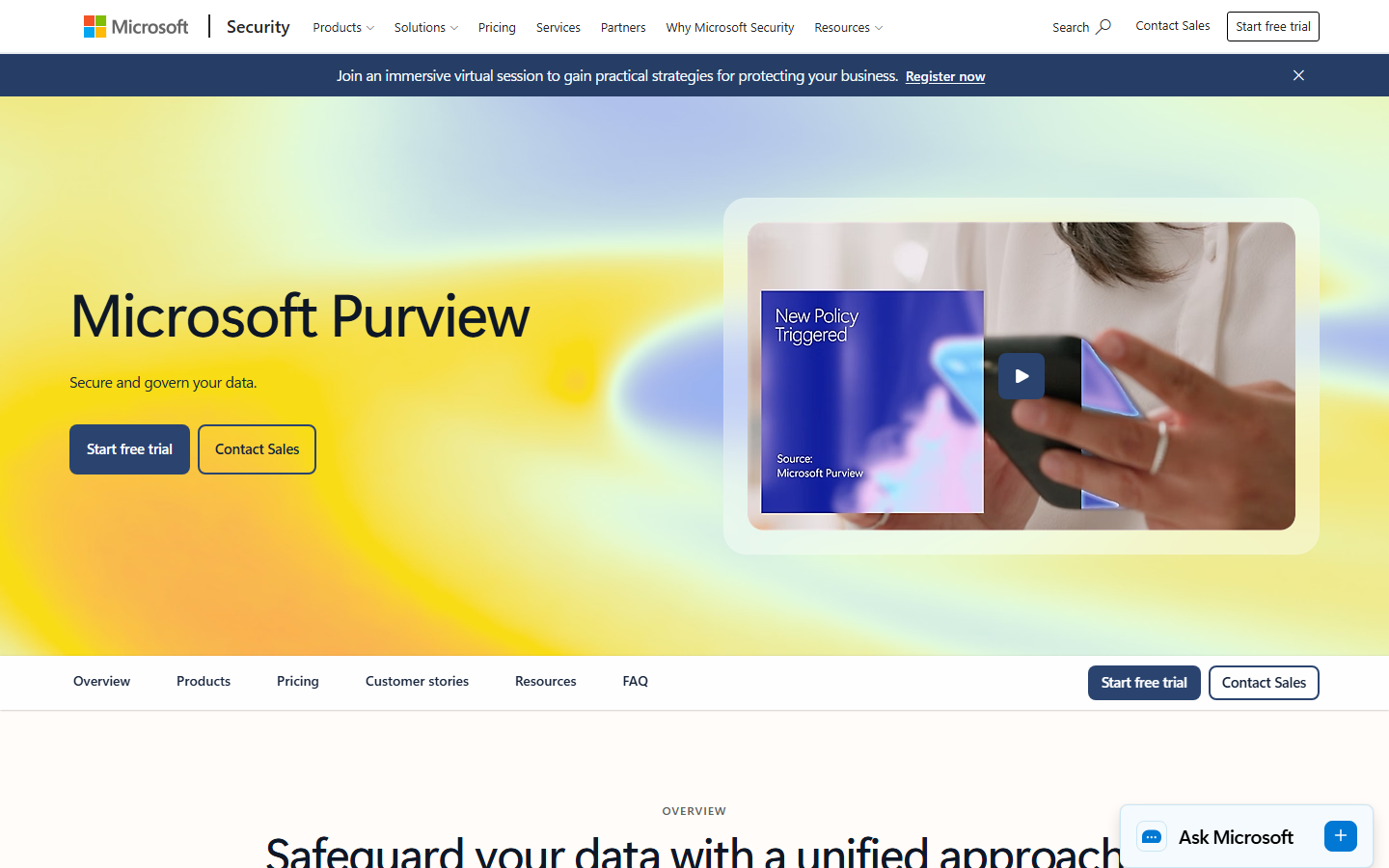
6. Microsoft Purview

Source: Microsoft Purview website (microsoft.com, captured August 2026).
  • Best for: organisations standardised on Azure, Fabric and Power BI.
  • Strengths: native integration with no extra vendor to onboard, sensible defaults, and lineage that arrives with the platform rather than as a purchase.
  • Trade offs: coverage largely stops at the edge of the Microsoft estate, and column level depth is uneven across sources. Most regulated enterprises run at least one platform Purview sees poorly.
  • Pricing: consumption based inside the Azure agreement.

7. Databricks Unity Catalog

Unity Catalog captures lineage automatically for anything that runs on Databricks, down to column level, with no configuration to speak of. For a team whose entire estate is Databricks this is often enough on its own, and it is already paid for.

  • Best for: Databricks first organisations with little outside the lakehouse.
  • Strengths: automatic column level capture, zero integration work, and lineage applied exactly where the work happens.
  • Trade offs: anything outside Databricks is invisible to it, including the operational systems the data came from and often the dashboards it ends up in.
  • Pricing: included in Databricks consumption.

8. Solidatus

Solidatus takes the opposite approach to almost everything else on this list. Lineage is modelled as a graph that people build and maintain, which sounds like a weakness until you meet the case it was designed for: regulatory reporting in a bank, where the trace has to include processes and controls that no query log will ever record.

  • Best for: financial services regulatory reporting programmes, where lineage must cover manual steps and controls as well as systems.
  • Strengths: genuinely good modelling of business process alongside technical flow, strong versioning so a past state can be reproduced, and a track record in banking regulatory work.
  • Trade offs: the model is only as current as the people maintaining it. Automated capture is limited compared with the parsing tools.
  • Pricing: not published.

9. Octopai

Octopai is a lineage specialist built for traditional business intelligence estates, the kind where data moves through an established extract and load tool into a reporting layer that a large organisation has run for a decade. It reads those technologies well and makes no attempt to be a governance platform.
  • Best for: teams whose lineage problem lives in older business intelligence and extract, transform and load technology rather than in a cloud warehouse.
  • Strengths: fast time to first useful map on the platforms it supports, cross system tracing inside those estates, and a narrow product that does one job.
  • Trade offs: narrower modern platform coverage than the general catalogs, and it will not serve as your governance system of record.
  • Pricing: not published.

10. OpenMetadata

Source: OpenMetadata website (open-metadata.org, captured August 2026).
  • Best for: engineering led teams that want column level lineage without a licence and have the people to run it.
  • Strengths: the strongest open source option for column level lineage parsed from query logs, an active project, and a single unified metadata model that is easier to work with than the alternatives.
  • Trade offs: you own the deployment, the upgrades and the connector gaps. Support is a community unless you buy the commercial offering.
  • Pricing: free and open source. Managed commercial version available.

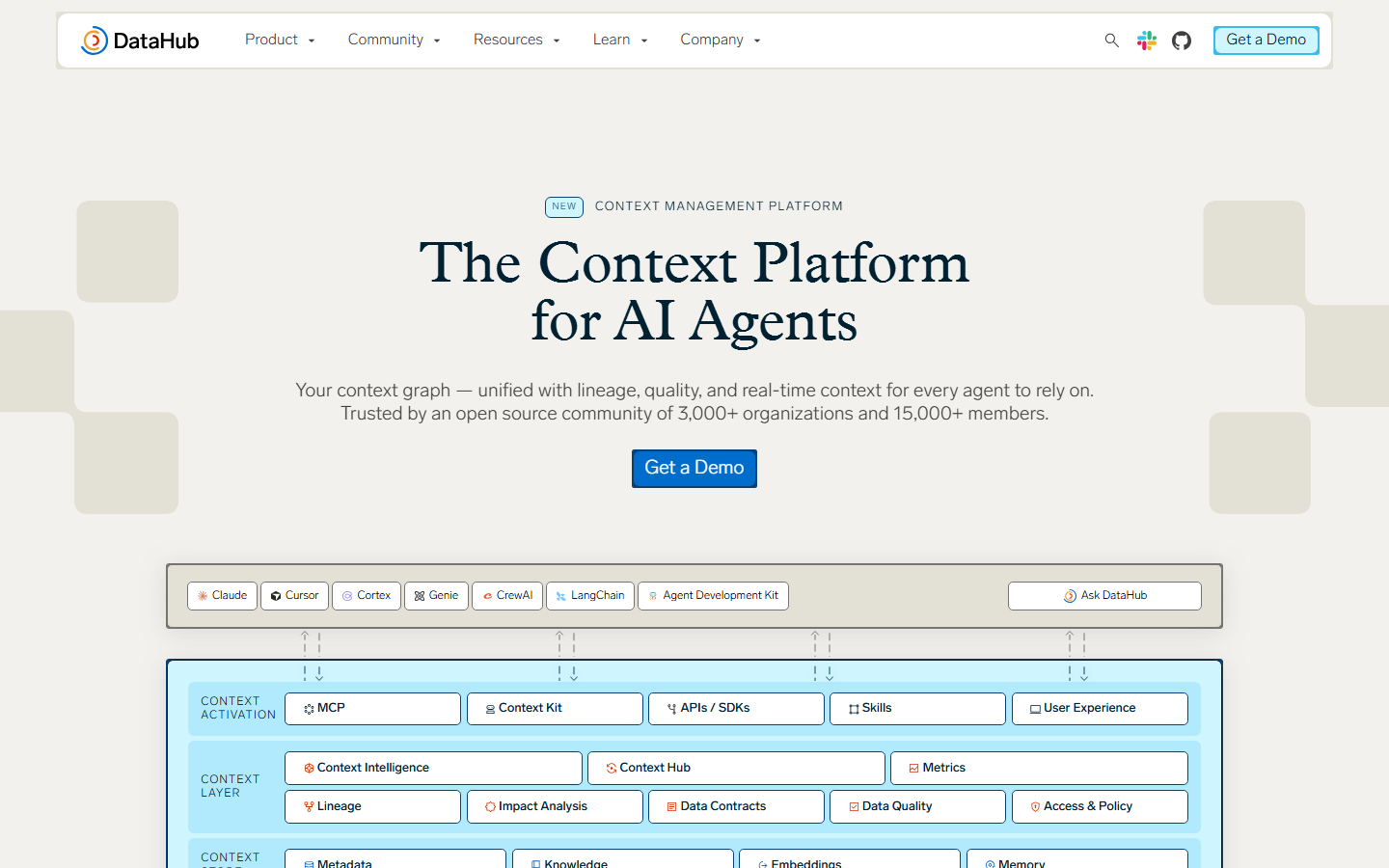
11. DataHub

Source: DataHub website (datahub.com, captured August 2026).
  • Best for: large engineering organisations that want to extend and embed metadata rather than buy a finished product.
  • Strengths: built at LinkedIn scale, event driven architecture, wide connector coverage and a genuinely extensible model. Column level lineage is supported for the main warehouses.
  • Trade offs: the operational burden is real and the learning curve is steep. Teams without a dedicated platform engineer usually regret it.
  • Pricing: free and open source. Managed commercial version available.

12. Amundsen

Amundsen came out of Lyft and remains a clean, lightweight discovery tool. It is included here because it still appears on most lists, but a buyer should know that its lineage is the weakest of the three open source options and development has been quieter than the alternatives.

  • Best for: teams whose real need is search and discovery, with lineage as a secondary concern.
  • Strengths: simple to stand up, easy for analysts to use, and light on operational cost.
  • Trade offs: lineage is largely table level and depends on what you feed it. If lineage is the requirement, OpenMetadata or DataHub is the better open source starting point.
  • Pricing: free and open source.

13. Secoda

Secoda is the lightweight end of the catalog market, aimed at teams that want lineage and documentation working within days rather than quarters. The bet it makes is that speed of adoption beats depth of governance for a team of twenty analysts, which for that team is often correct.
  • Best for: small and mid sized data teams that want lineage running quickly without a governance programme around it.
  • Strengths: quick setup, clean interface, strong search, and a price point that a mid sized team can approve without a procurement cycle.
  • Trade offs: lighter governance workflow and audit evidence than the enterprise platforms, and depth of lineage varies by connector.
  • Pricing: published tiers on the vendor site, with custom pricing at enterprise scale.

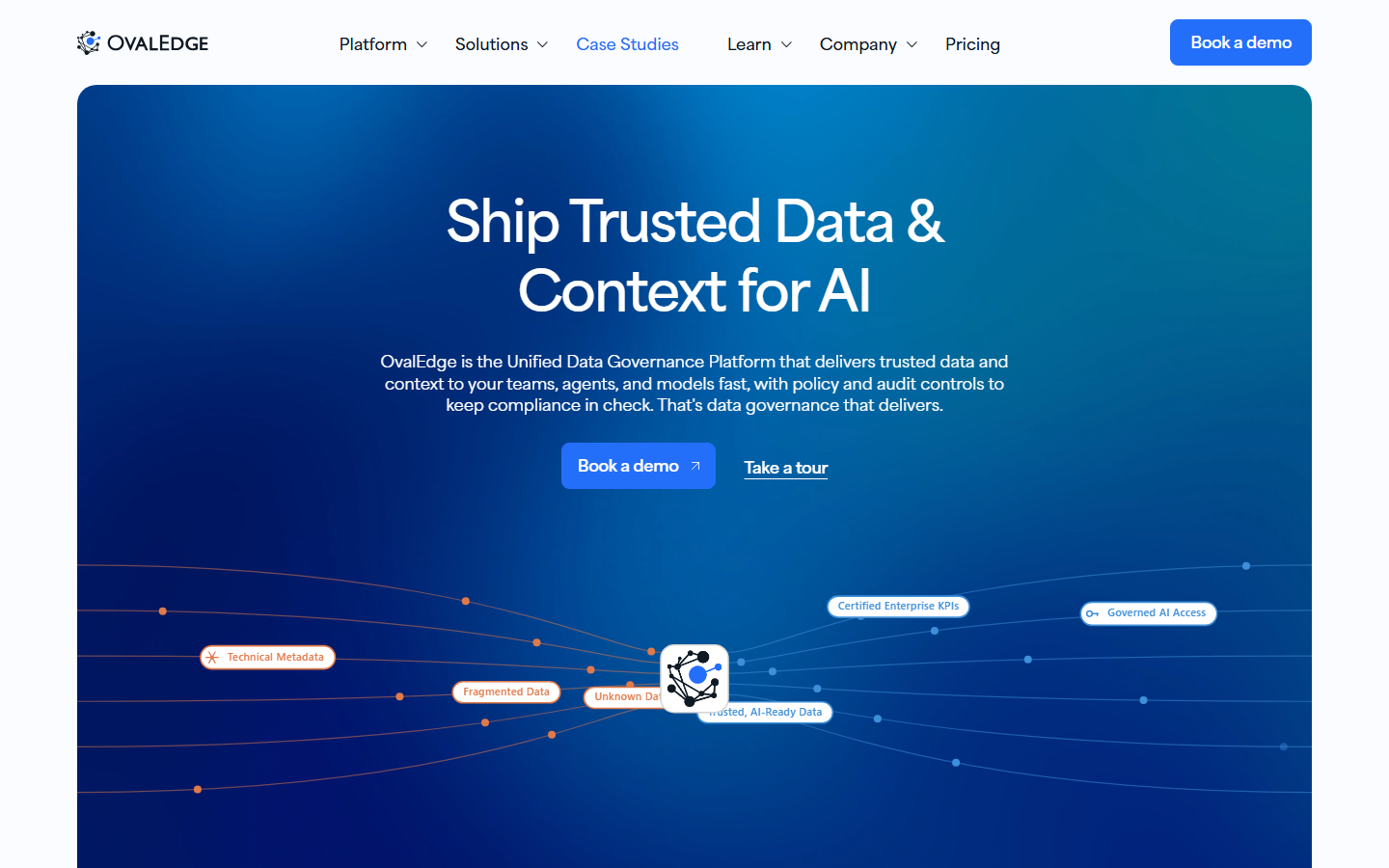
14. OvalEdge

Source: OvalEdge website (ovaledge.com, captured August 2026).
  • Best for: mid market organisations that want catalog, governance and lineage from one vendor at a mid market price.
  • Strengths: unusually transparent about packaging and pricing for this category, broad connector coverage, and a governance feature set that punches above its price.
  • Trade offs: the interface feels dated next to the newer products, and lineage depth is inconsistent across less common sources.
  • Pricing: published packages on the vendor site, plus implementation.

15. dbt

dbt is not a lineage tool and does not claim to be, but it is on this list because it is where a great deal of lineage actually originates. Every model declares its dependencies, so dbt knows the transformation graph exactly, and the paid tiers surface column level lineage over it. Several products above build their best lineage by reading dbt.
  • Best for: teams whose transformations already live in dbt and who want lineage over that layer without buying a catalog.
  • Strengths: the lineage is exact rather than inferred, because it comes from the code that runs. Documentation and testing sit in the same place.
  • Trade offs: it sees the transformation layer and nothing else. What happened before the data reached dbt, and what happens after it leaves for a dashboard, is outside its view.
  • Pricing: free open source core, paid cloud tiers for the hosted product.

16. Monte Carlo

Source: Monte Carlo website (montecarlodata.com, captured August 2026).
  • Best for: teams whose first problem is broken pipelines and stale dashboards rather than audit evidence.
  • Strengths: the strongest incident detection in data observability, with lineage used well to trace the blast radius of a failure to the reports it touched.
  • Trade offs: lineage exists to serve incident response, so it is not built as a governance record. Depth outside the supported warehouses is limited, and pricing is at the higher end.
  • Pricing: not published.

17. Metaplane

Source: Metaplane website (metaplane.dev, captured August 2026).
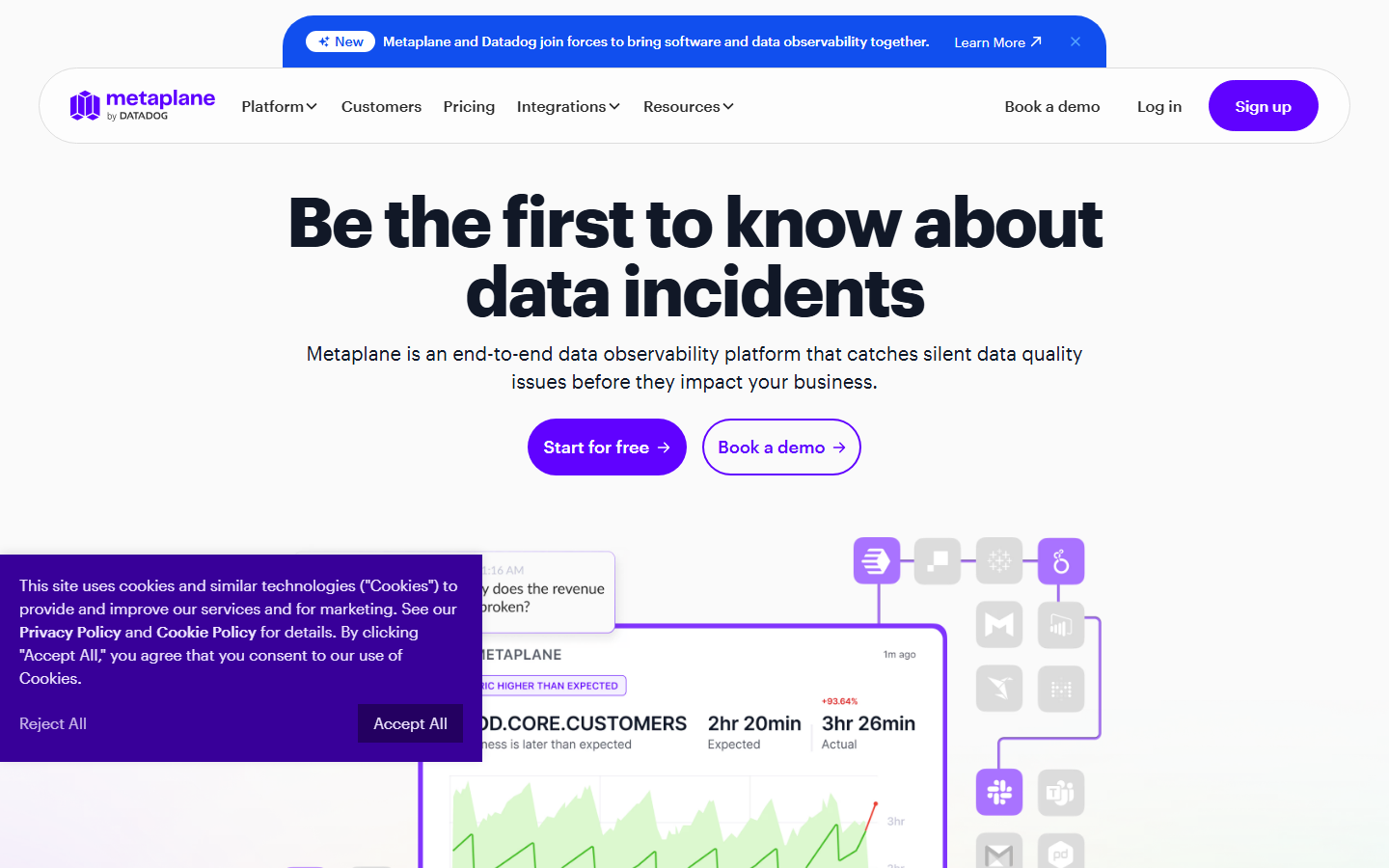
  • Best for: smaller teams that want observability with column level lineage and a short setup.
  • Strengths: quick to deploy, sensible automated anomaly detection, and column level lineage on the main warehouses without a long project.
  • Trade offs: narrower platform coverage than the enterprise tools, and governance workflow is not the product.
  • Pricing: published tiers including a free plan, with custom pricing above them.

18. Acceldata

Source: Acceldata website (acceldata.io, captured August 2026).
  • Best for: large hybrid estates where compute cost and pipeline reliability are governed together.
  • Strengths: unusually broad coverage across cloud and on premises platforms, and it combines pipeline reliability with spend visibility, which few others do.
  • Trade offs: breadth brings complexity, and the lineage view is oriented to operations rather than to producing an audit answer.
  • Pricing: not published.

Data Lineage Tools Compared

The table is the fast version of everything above. Column level means the trace resolves to individual fields rather than stopping at the table. Lineage source describes how the map is produced, since parsed lineage maintains itself and declared lineage does not. Cross platform means the trace continues when data leaves the vendor's own environment.

ToolColumn level lineageHow lineage is producedWorks across platformsPricing
DecubeYesParsed from queries and codeYesFrom 21,000 USD a year
AtlanYesParsed, strongest via dbtYesNot published
AlationPartialParsed, varies by sourceYesNot published
CollibraPartialParsed and declaredYesNot published
InformaticaYesParsed from code including legacyYesConsumption based
Microsoft PurviewPartialParsed inside Microsoft estatePartialConsumption based
Databricks Unity CatalogYesCaptured automatically at runtimeNoIncluded in Databricks
SolidatusYesDeclared and modelled by peopleYesNot published
OctopaiYesParsed from business intelligence toolsPartialNot published
OpenMetadataYesParsed from query logsYesFree and open source
DataHubYesParsed plus ingested metadataYesFree and open source
AmundsenNoIngested from what you supplyPartialFree and open source
SecodaPartialParsed from query logsYesPublished tiers
OvalEdgePartialParsed and declaredYesPublished packages
dbtPartialDeclared in model codeNoFree core, paid cloud
Monte CarloYesParsed from query logsPartialNot published
MetaplaneYesParsed from query logsPartialPublished tiers
AcceldataPartialParsed from pipelinesYesNot published

Table Level or Column Level: The Question That Decides It

Most disappointment in this category traces back to buying table level lineage and needing column level lineage. Table level tells you that a report depends on a table. Column level tells you that the margin figure in that report depends on one field in one table, which was changed by one pull request three weeks ago.

The practical test is an impact analysis. Somebody proposes changing a column type in a source system. With table level lineage the answer is that forty reports touch that table and somebody should probably check them all. With column level lineage the answer is that three reports read that specific field and here they are. The first answer costs a week of analyst time every time it is asked. The second costs a minute. Our guide to column level lineage explains the technique in depth, and the point here is narrower: verify it per connector before you sign.

Vendors rarely lie about this, but they do generalise. A product can be genuinely column level on Snowflake and table level on the legacy database that half your reporting still depends on. Ask for the list of sources where column level resolution is supported, source by source, and match it against your own estate rather than against the marketing page.

Parsed or Declared: Why Lineage Goes Stale

Lineage is produced in one of two ways, and the difference decides how much work you are signing up for after the implementation ends.

Parsed lineage is read from query history, transformation code and platform metadata. The tool watches what actually ran and reconstructs the map from it. When an engineer changes a pipeline, the map changes on the next parse without anybody being told. The limitation is that the tool can only see what it can read, so anything moving through a script it cannot parse is a blank space on the map.

Declared lineage is drawn by people. Somebody models the flow, including steps no machine records, such as a control performed by a person or a file emailed between two teams. The strength is coverage of the parts of a process that leave no technical trace. The weakness is decay, because the diagram is accurate on the day it is drawn and slightly less accurate every day after that.

Regulated reporting programmes usually need both, which is why Solidatus and Collibra keep appearing in banks alongside a parsing tool. If you can only have one, take parsed, then add declared coverage for the specific processes that genuinely have no technical trace. Doing it the other way round produces a beautiful diagram that nobody trusts by the second audit.

Does the Trace Survive Outside One Platform

Platform native lineage is free, accurate and limited. Unity Catalog knows everything that happens inside Databricks and nothing that happens outside it. Purview is strong across the Microsoft estate and weaker beyond it. dbt sees the transformation layer perfectly and neither end of the journey.

That is fine until an auditor asks where a number came from, because the answer usually starts in an operational database, passes through an ingestion tool, lands in a warehouse, gets transformed, and finishes in a dashboard. Native lineage covers one segment of that chain. A regulator asks about the whole chain.

The test to run in the demo is simple. Pick one real number that appears in a report your business cares about, and ask the vendor to trace it back to the operational system it originated in, showing every hop. Products that only cover part of the chain will reformulate the question. That reformulation is the answer.

What Data Lineage Tools Cost

Four positions exist in this market, and knowing which one a vendor occupies before the first call saves a month.

Open source products carry no licence fee and a standing engineering cost. Running OpenMetadata or DataHub properly is a part time job for a platform engineer at minimum, plus infrastructure, plus the upgrade cycle. The licence saving is real and so is the salary it is spent on, so compare against a commercial quote honestly rather than treating free as zero.

Platform included lineage is metered inside a bill you already pay, which makes it the cheapest option available if it covers your estate, and an expensive false economy if it does not. Mid market catalogs publish packages and land where a mid sized team can approve them without a procurement committee. Enterprise platforms quote, commonly at six figures a year including implementation services, and the number scales with the count of sources connected rather than with seats.

The variable that moves an enterprise quote most is the number of systems in scope, which is the number most organisations cannot state accurately when they start shopping. Counting your sources before the first demo is the cheapest negotiating work available to you.

How to Choose: Five Decision Rules

Feature checklists are not how these decisions get made. These five rules settle it faster.

  • Start from the question you have to answer, not the feature list. If the question is why a dashboard broke, an observability tool is the right purchase. If the question is how a reported number was produced and who approved the change, you need a governance grade trace. Those are different products and buying the wrong one is the most common mistake here.
  • Verify column level support source by source. Column level on the flagship warehouse and table level on everything else is the normal shape of these products. Get the supported list in writing and check it against your own systems.
  • Trace one real number end to end in the demo. Not a sample dataset. One number your finance or risk team recognises, traced from the report back to the operational system. Every product demos well on prepared data.
  • Count your sources before you shop. The quote scales with that count, and so does the implementation. Teams that cannot count them usually find the total is well above the estimate.
  • Ask who maintains the map after go live. If the answer involves people redrawing diagrams, price that person in and expect the coverage to decay. If the answer is that it reparses itself, ask what it cannot parse.

If you want the short version, the table below routes the most common starting points to the kind of product that fits them.

If your starting point isThe right kind of tool isExamples in this list
Proving to a regulator how a number was producedGovernance grade lineage that spans platformsDecube, Collibra, Informatica, Solidatus
Everything runs in one cloud platform alreadyNative lineage you already pay forDatabricks Unity Catalog, Microsoft Purview
Dashboards break and the cause is hard to findData observability with lineage for impact analysisMonte Carlo, Metaplane, Acceldata
Analysts cannot find or trust the dataA catalog with lineage supporting discoveryAtlan, Alation, Secoda, OvalEdge
Engineering capacity is available and budget is notOpen source metadata platformsOpenMetadata, DataHub
Lineage must cover manual controls and processesDeclarative lineage modellingSolidatus, Collibra

Regulators That Change the Shortlist

Almost all English language coverage of lineage is written as though European rules are the only ones that exist. For many teams the local supervisor arrives first and asks for something more specific.

RegulatorWho it coversWhat it tends to ask for
OJK, IndonesiaBanks, insurers and financial technology firmsEvidence of data quality and control over systems handling customer data, reported locally.
APRA, AustraliaBanks, insurers and superannuation fundsNamed accountability for a system and demonstrable control over critical data elements.
MAS, SingaporeFinancial institutionsFairness, ethics, accountability and transparency for models that affect customers.
NAIC, United StatesInsurers, at state levelDocumentation and governance for models used in underwriting and claims.
EU AI ActSystems placed on the European Union marketRisk classification, logging and record keeping. High risk from 2 December 2027 or 2 August 2028.

Every one of those asks the same underlying question in a different accent: show us where this came from and who was responsible. A product with excellent European templates and no answer for an Asia Pacific supervisor still leaves the work with you. Ask a vendor directly which of your regulators it has produced evidence for before.

Lineage Is What Turns an AI Governance Policy Into Evidence

The reason lineage buying has become urgent again is that AI systems now read the data and act on it. A governance policy can state that a model may only use approved, current, permitted data. The policy is a statement of intent. Only lineage can show what the model actually read on the day it produced the output somebody is now asking about.

That distinction is what separates an attestation from an audit answer, and it is why Decube data governance is built up from the data layer rather than down from a compliance questionnaire. Extending the same trace to the systems that consume the data is covered in our guide to agent lineage.

The timetable is also worth getting right, because a good deal of published content is now wrong about it. The European Union Digital Omnibus on AI entered into force on 27 July 2026 and moved the high risk obligations. Standalone high risk systems have until 2 December 2027, and high risk systems embedded in regulated products such as medical devices and machinery have until 2 August 2028. Rules for general purpose AI models and the Article 50 transparency obligations were not changed and still apply from 2 August 2026. If a vendor is selling you urgency based on the old date, that tells you how closely it tracks the regulation it claims to help you meet.

Four Mistakes That Cost the Most

  • Buying table level lineage for a column level problem. The demo looks identical. The difference only appears the first time somebody asks which field caused the discrepancy, by which time the contract is signed.
  • Treating open source as free. The licence is free and the operating cost is a person. That trade is often worth making, but it has to be made deliberately rather than discovered in the second quarter.
  • Accepting native lineage as full coverage. It is genuinely excellent inside its own platform. The audit gap is always at the boundary, which is exactly where native tools stop.
  • Letting the map be maintained by hand without funding the hand. Declared lineage decays quietly. Nobody notices until an auditor traces a flow that was decommissioned last year.

Frequently Asked Questions

What are data lineage tools?

Data lineage tools record where data came from, how it was transformed and where it is used, then present that trace so a team can answer questions about it. The better ones build the map automatically by parsing query history and transformation code, so it stays current as pipelines change rather than needing to be redrawn by hand.

What is the best data lineage tool in 2026?

There is no single best tool because the category splits by the problem you are solving. For proving to a regulator how a reported number was produced across more than one platform, a governance grade option such as Decube, Collibra, Informatica or Solidatus fits. For finding out why a dashboard broke, an observability tool such as Monte Carlo or Metaplane is the better buy. For discovery and adoption across analysts, a catalog such as Atlan or Alation fits best.

How much do data lineage tools cost?

Most vendors do not publish pricing. Open source options such as OpenMetadata, DataHub and Amundsen carry no licence fee but need engineering time to run. Platform native lineage from Databricks or Microsoft is metered inside a bill you already pay. Mid market catalogs publish packages, and enterprise platforms quote, commonly at six figures a year including implementation. The number of sources connected moves the quote more than the number of seats.

What is the difference between table level and column level lineage?

Table level lineage shows that a report depends on a table. Column level lineage shows that a specific figure in that report depends on a specific field in that table. Column level is what an impact analysis and an audit response both need, because it answers which field changed rather than which table was involved.

Are there free or open source data lineage tools?

Yes. OpenMetadata and DataHub both provide column level lineage parsed from query logs and are free to use, and Amundsen provides lighter discovery focused lineage. All three shift the cost from a licence to engineering time, since you own the deployment, the upgrades and the connector gaps. Both OpenMetadata and DataHub also offer a managed commercial version.

How is data lineage different from a data catalog?

A catalog is an inventory that tells you what data exists, what it means and who owns it. Lineage is the trace that tells you where a given piece of data came from and what depends on it. Most catalogs include some lineage and most lineage tools include some cataloging, so the question to ask a vendor is which of the two is the product and which is the feature.

Do I need data lineage for AI governance?

For anything a regulator will review, yes. An AI governance policy states which data a model is permitted to use, but only lineage shows what the model actually read on a given date. Without that trace you can attest that a control existed and you cannot prove it held, which is the distinction supervisors care about.

What is data lineage?

Data lineage is the record of where data came from, every transformation applied to it along the way, and every place it ends up. It answers where a number originated and what would break if a source changed. This article covers how to choose a tool for it, and our data lineage concepts guide covers the definitions and worked examples in full.

Is Atlan worth it?
Atlan is worth it if your primary need is a modern data catalog with strong column-level lineage and cloud-native integrations (Snowflake, dbt, Databricks). It is harder to justify if you also need data observability and quality coverage across a heterogeneous stack — those capabilities require separate vendors, adding cost and complexity.
What is the best Atlan alternative
Decube is purpose-built for regulated financial services, with native observability, approval-gated lineage, PII auto-classification, and an AI layer (TrustyAI) that does not route metadata to a public LLM. These map directly to regulatory frameworks supervised by MAS, OJK, BNM, and APRA. Atlan AI's OpenAI dependency is often a procurement blocker in these environments.
How does Atlan compare to Alation?
Both are catalog-first platforms with strong discovery. Alation pioneered search-first data culture and analyst adoption. Atlan is stronger on column-level lineage and cloud integrations. Both require external tooling for observability and broad data quality coverage.
How long does it take to migrate from Atlan to another platform?
Migration time depends on estate size and the number of active integrations. SaaS-native platforms like Decube deploy in 2–6 weeks without professional services. The longer task is typically re-establishing business glossaries, data ownership, and custom attributes — that effort is roughly the same regardless of which platform you move to.
What is the difference between a context layer and a semantic layer?
A semantic layer standardizes how metrics are defined and calculated so every analyst and BI tool uses the same numbers. A context layer encodes governance rules, data lineage, quality signals, and organizational knowledge so AI agents can make safe, autonomous decisions. The semantic layer is for human-facing analytics. The context layer is for AI-facing autonomy.
Can I use a semantic layer without a context layer?
Yes - and most organizations do today. If your primary consumers are human analysts using BI tools, a semantic layer alone is sufficient. The context layer becomes essential when you introduce AI agents that need to understand not just what a metric means but whether and how they are allowed to use it.
Is a context layer the same as a data catalog?
No. A data catalog is a component of a context layer. The catalog inventories data assets and stores metadata. The context layer activates that metadata by delivering it to AI agents at query time through APIs and MCP connections. Modern platforms like Atlan extend catalog functionality into full context layer infrastructure.
Which tool implements a context layer?
Purpose-built context layer platforms include Decube, which combines catalog, lineage, quality, and governance into a metadata layer that delivers context to AI agents via MCP. You can also build a context layer on custom infrastructure using a vector database (for semantic search), a knowledge graph
How long does it take to implement a context layer?
Most enterprise context layer implementations take 8–16 weeks when using a purpose-built platform like Atlan. Building from scratch on custom infrastructure typically takes 6–12 months. The timeline depends heavily on how much governance metadata already exists and how many data sources need to be connected.
What is Data Context?
Data Context is the information that explains what data means, where it comes from, how it is transformed, whether it can be trusted, and how it should be used. It combines metadata, lineage, data quality, and governance so people and systems can confidently use data for analytics, reporting, and AI.
How is Data Context different from metadata?
Metadata describes data, while Data Context makes data usable and trustworthy. Metadata provides definitions, ownership, and technical details. Data Context extends this by adding lineage, quality signals, and governance rules, creating a complete, operational understanding of data.
Why is Data Context important for AI?
AI systems require Data Context to interpret data correctly, safely, and reliably. Without context, AI models may misunderstand metrics, use stale or incorrect data, or expose sensitive information. Data Context ensures AI uses trusted, well-defined, and policy-compliant data.
How does data lineage contribute to Data Context?
Data lineage provides visibility into how data flows and transforms across systems. It shows upstream sources, downstream dependencies, and transformation logic, enabling impact analysis, root-cause investigation, and confidence in reported numbers.
How do organizations build Data Context in practice?
Organizations build Data Context by unifying metadata, lineage, observability, and governance into a single operational layer. This includes defining business meaning, capturing end-to-end lineage, monitoring data quality, and enforcing usage policies directly within data workflows.
What is Context Engineering?
Context Engineering is the practice of designing and operationalizing business meaning, data lineage, quality signals, ownership, and policy constraints so that both humans and AI systems can reliably understand and act on enterprise data. Unlike traditional metadata management, Context Engineering focuses on decision-grade context that can be consumed programmatically by AI agents in real time.
How is Context Engineering different from prompt engineering?
Prompt engineering focuses on how questions are phrased for an AI model, while Context Engineering focuses on what the AI system already knows before a question is asked. In enterprise environments, context includes data definitions, lineage, quality, and usage constraints—making Context Engineering foundational for trustworthy and scalable Agentic AI.
Why is Context Engineering critical for Agentic AI?
Agentic AI systems reason, decide, and act autonomously across multiple systems. Without engineered context—such as trusted data meaning, lineage, and real-time quality signals—agents cannot assess risk or impact correctly. Context Engineering ensures AI agents act safely, explain decisions, and know when to pause or escalate.
What are the core components of Context Engineering?
The four core components of Context Engineering are: Semantic context (business meaning and definitions) Lineage context (end-to-end data flow and dependencies) Operational context (data quality and reliability signals) Policy context (privacy, compliance, and usage constraints) Together, these form a unified context layer that supports enterprise decision-making and AI automation
How should enterprises prepare for Context Engineering?
Enterprises should follow a phased approach: Inventory critical data and trust gaps Unify metadata, lineage, quality, and policy into a single context layer Expose context through APIs for AI agent consumption By 2026, this foundation will be essential for deploying Agentic AI at scale with confidence and auditability.
How do you measure the ROI of a data catalog?
ROI is measured by comparing the quantifiable benefits (such as reduced data search time, fewer data quality issues, and lower compliance effort) against the total costs (implementation, licensing, and support). Typical metrics include time savings, productivity gains, and compliance cost reduction.
What is a data catalog and why is it important for ROI?
A data catalog is a centralized inventory of data assets enriched with metadata that helps users find, understand, and trust data across an organization. It improves data discovery, reduces search time, and enhances collaboration — all of which contribute to measurable ROI by cutting operational costs and accelerating insights.
How quickly can businesses see ROI after implementing a data catalog?
Time-to-value varies with deployment and adoption, but many organizations begin seeing measurable improvements in days to months, especially through faster data discovery and reduced compliance effort. Early wins in these areas can quickly justify the investment.
What factors should you include when calculating the ROI of a data catalog?
When calculating ROI, include: Implementation and training costs Recurring maintenance and licensing fees Savings from reduced data search and rework Compliance cost reductions Productivity and decision-making improvements This ensures a holistic view of both costs and benefits.
How does a data catalog support data governance and compliance ROI?
A data catalog enhances governance by classifying data, enforcing rules, and providing transparency. This reduces regulatory risk and compliance effort, leading to direct cost savings and stronger data trust.
What is data lineage?
Data lineage shows where data comes from, how it moves, and how it changes across systems. It helps teams understand the full journey of data—from source to final reports or AI models.
Why is data lineage important for modern data teams?
Data lineage builds trust in data by making it transparent and explainable. It helps teams troubleshoot issues faster, assess impact before changes, meet compliance requirements, and confidently use data for analytics and AI.
What are the different types of data lineage?
Common types of data lineage include: Technical lineage – Tracks data movement at table and column level. Business lineage – Connects data to business definitions and metrics. Operational lineage – Shows how pipelines and jobs process data. End-to-end lineage – Combines all of the above across systems.
Is data lineage only useful for compliance?
No. While data lineage is critical for audits and regulatory compliance, it is equally valuable for debugging data issues, impact analysis, cost optimization, and AI readiness.
How does data lineage help with data quality?
Data lineage helps identify where data quality issues originate and which reports or dashboards are affected. This reduces time spent on root-cause analysis and improves accountability across data teams.
What is Metadata Management?
Metadata management involves the management and organization of data about data to enhance data governance, data asset quality, and compliance.
What are the key points of Metadata Management?
Metadata management involves defining a metadata strategy, establishing roles and policies, choosing the right metadata management tool, and maintaining an ongoing program.
How does Metadata Management work?
Metadata management is essential for improving data quality and relevance, utilizing metadata management tools, and driving digital transformation.
Why is Metadata Management important for businesses?
Metadata management is important for better data quality, usability, data insights, compliance adherence, and improved accuracy in data cataloging.
How should companies evolve their approach to Metadata Management?
Companies should manage all types of metadata across different environments, leverage intelligent methods, and follow best practices to maximize data investments.
What is a data definition example?
A data definition example could be: “Customer: a person or entity that has made at least one purchase within the past year.” It clearly sets business meaning and inclusion criteria.
Why is data definition important in data governance?
It ensures everyone interprets data consistently, reducing ambiguity and improving compliance, reporting, and collaboration.
Who should own data definitions?
Ownership should be shared between business domain experts (for context) and data stewards (for technical accuracy).
How often should data definitions be reviewed?
Ideally quarterly or whenever there’s a structural change in business logic, data models, or product offerings.
What’s the difference between data definition and data catalog?
A data catalog inventories data assets; data definition explains what those assets mean. Combined, they create full visibility and trust.
Why is Data Lineage important for businesses?
Data Lineage provides transparency and trust in your data ecosystem. It helps organizations ensure data accuracy, simplify root-cause analysis during data quality issues, and maintain compliance with regulations like GDPR or SOX. By understanding data flows, teams can make faster, more reliable decisions and improve overall data governance.
What are the key components of Data Lineage?
The main components of Data Lineage include: Data Sources: Where the data originates (databases, APIs, files). Transformations: How data is processed or modified. Data Pipelines: The tools or systems that move data. Destinations: Where the data is stored or consumed (dashboards, reports, models). Metadata: The contextual details that describe each step in the data’s lifecycle.
How does Data Lineage support Data Governance and AI readiness?
Data Lineage acts as the foundation for strong data governance by providing visibility into data ownership, transformation logic, and usage. For AI initiatives, lineage ensures that models are trained on accurate and traceable data, making AI outputs more explainable and trustworthy. Platforms like Decube’s Data Trust Platform unify lineage with data quality and metadata management to help enterprises achieve AI readiness.
What tools are commonly used for Data Lineage?
Several tools help automate and visualize data lineage, such as Decube, Atlan, Alation, Collibra, and OpenLineage. These tools connect to data warehouses, ETL pipelines, and BI tools to automatically map relationships between datasets — saving time and reducing manual effort.
What is Data Lineage?
Data Lineage is the process of tracking how data moves and transforms across an organization — from its origin to its final destination. It shows where data comes from, how it changes through different systems or pipelines, and where it ends up being used. In short, data lineage helps you visualize the journey of your data.
What does “data context” mean?
Data context refers to the semantic, structural, and business information that surrounds raw data. It explains what data means, where it comes from, who owns it, and how it should be used.
What is a centralized LLM framework?
It’s an enterprise-wide system where all departments access AI through a shared platform, equipped with guardrails, context layers, and multimodal capabilities.
What are guardrails in AI?
Guardrails are controls—policies, access restrictions, and compliance checks—that ensure AI outputs are secure, ethical, and aligned with enterprise goals.
How does data context affect ROI in AI?
Models trained or prompted with contextualized data deliver outputs that are relevant, trustworthy, and actionable—leading to faster adoption and higher business value.
What is MCP (Model Context Protocol) and why does it matter?
MCP defines how models interact with external tools and data sources. Feeding it with strong context ensures the AI agent can act accurately and responsibly.
What is a Data Trust Platform in financial services?
A Data Trust Platform is a unified framework that combines data observability, governance, lineage, and cataloging to ensure financial institutions have accurate, secure, and compliant data. In banking, it enables faster regulatory reporting, safer AI adoption, and new revenue opportunities from data products and APIs.
Why do AI initiatives fail in Latin American banks and fintechs?
Most AI initiatives in LATAM fail due to poor data quality, fragmented architectures, and lack of governance. When AI models are fed stale or incomplete data, predictions become inaccurate and untrustworthy. Establishing a Data Trust Strategy ensures models receive fresh, auditable, and high-quality data, significantly reducing failure rates.
What are the biggest data challenges for financial institutions in LATAM?
Key challenges include: Data silos and fragmentation across legacy and cloud systems. Stale and inconsistent data, leading to poor decision-making. Complex compliance requirements from regulators like CNBV, BCB, and SFC. Security and privacy risks in rapidly digitizing markets. AI adoption bottlenecks due to ungoverned data pipelines.
How can banks and fintechs monetize trusted data?
Once data is governed and AI-ready, institutions can: Reduce OPEX with predictive intelligence. Offer hyper-personalized products like ESG loans or SME financing. Launch data-as-a-product (DaaP) initiatives with anonymized, compliant data. Build API-driven ecosystems with partners and B2B customers.
What is data dictionary example?
A data dictionary is a centralized repository that provides detailed information about the data within an organization. It defines each data element—such as tables, columns, fields, metrics, and relationships—along with its meaning, format, source, and usage rules. Think of it as the “glossary” of your data landscape. By documenting metadata in a structured way, a data dictionary helps ensure consistency, reduces misinterpretation, and improves collaboration between business and technical teams. For example, when multiple teams use the term “customer ID”, the dictionary clarifies exactly how it is defined, where it is stored, and how it should be used. Modern platforms like Decube extend the concept of a data dictionary by connecting it directly with lineage, quality checks, and governance—so it’s not just documentation, but an active part of ensuring data trust across the enterprise.
What is an MCP Server?
An MCP Server stands for Model Context Protocol Server—a lightweight service that securely exposes tools, data, or functionality to AI systems (MCP clients) via a standardized protocol. It enables LLMs and agents to access external resources (like files, tools, or APIs) without custom integration for each one. Think of it as the “USB-C port for AI integrations.”
How does MCP architecture work?
The MCP architecture operates under a client-server model: MCP Host: The AI application (e.g., Claude Desktop or VS Code). MCP Client: Connects the host to the MCP Server. MCP Server: Exposes context or tools (e.g., file browsing, database access). These components communicate over JSON‑RPC (via stdio or HTTP), facilitating discovery, execution, and contextual handoffs.
Why does the MCP Server matter in AI workflows?
MCP simplifies access to data and tools, enabling modular, interoperable, and scalable AI systems. It eliminates repetitive, brittle integrations and accelerates tool interoperability.
How is MCP different from Retrieval-Augmented Generation (RAG)?
Unlike RAG—which retrieves documents for LLM consumption—MCP enables live, interactive tool execution and context exchange between agents and external systems. It’s more dynamic, bidirectional, and context-aware.
What is a data dictionary?
A data dictionary is a centralized repository that provides detailed information about the data within an organization. It defines each data element—such as tables, columns, fields, metrics, and relationships—along with its meaning, format, source, and usage rules. Think of it as the “glossary” of your data landscape. By documenting metadata in a structured way, a data dictionary helps ensure consistency, reduces misinterpretation, and improves collaboration between business and technical teams. For example, when multiple teams use the term “customer ID”, the dictionary clarifies exactly how it is defined, where it is stored, and how it should be used. Modern platforms like Decube extend the concept of a data dictionary by connecting it directly with lineage, quality checks, and governance—so it’s not just documentation, but an active part of ensuring data trust across the enterprise.
What is the purpose of a data dictionary?
The primary purpose of a data dictionary is to help data teams understand and use data assets effectively. It provides a centralized repository of information about the data, including its meaning, origins, usage, and format, which helps in planning, controlling, and evaluating the collection, storage, and use of data.
What are some best practices for data dictionary management?
Best practices for data dictionary management include assigning ownership of the document, involving key stakeholders in defining and documenting terms and definitions, encouraging collaboration and communication among team members, and regularly reviewing and updating the data dictionary to reflect any changes in data elements or relationships.
How does a business glossary differ from a data dictionary?
A business glossary covers business terminology and concepts for an entire organization, ensuring consistency in business terms and definitions. It is a prerequisite for data governance and should be established before building a data dictionary. While a data dictionary focuses on technical metadata and data objects, a business glossary provides a common vocabulary for discussing data.
What is the difference between a data catalog and a data dictionary?
While a data catalog focuses on indexing, inventorying, and classifying data assets across multiple sources, a data dictionary provides specific details about data elements within those assets. Data catalogs often integrate data dictionaries to provide rich context and offer features like data lineage, data observability, and collaboration.
What challenges do organizations face in implementing data governance?
Common challenges include resistance from business teams, lack of clear ownership, siloed systems, and tool fragmentation. Many organizations also struggle to balance strict governance with data democratization. The right approach involves embedding governance into workflows and using platforms that unify governance, observability, and catalog capabilities.
How does data governance impact AI and machine learning projects?
AI and ML rely on high-quality, unbiased, and compliant data. Poorly governed data leads to unreliable predictions and regulatory risks. A governance framework ensures that data feeding AI models is trustworthy, well-documented, and traceable. This increases confidence in AI outputs and makes enterprises audit-ready when regulations apply.
What is data governance and why is it important?
Data governance is the framework of policies, ownership, and controls that ensure data is accurate, secure, and compliant. It assigns accountability to data owners, enforces standards, and ensures consistency across the organization. Strong governance not only reduces compliance risks but also builds trust in data for AI and analytics initiatives.
What is the difference between a data catalog and metadata management?
A data catalog is a user-facing tool that provides a searchable inventory of data assets, enriched with business context such as ownership, lineage, and quality. It’s designed to help users easily discover, understand, and trust data across the organization. Metadata management, on the other hand, is the broader discipline of collecting, storing, and maintaining metadata (technical, business, and operational). It involves defining standards, policies, and processes for metadata to ensure consistency and governance. In short, metadata management is the foundation—it structures and governs metadata—while a data catalog is the application layer that makes this metadata accessible and actionable for business and technical users.
What features should you look for in a modern data catalog?
A strong catalog includes metadata harvesting, search and discovery, lineage visualization, business glossary integration, access controls, and collaboration features like data ratings or comments. More advanced catalogs integrate with observability platforms, enabling teams to not only find data but also understand its quality and reliability.
Why do businesses need a data catalog?
Without a catalog, employees often struggle to find the right datasets or waste time duplicating efforts. A data catalog solves this by centralizing metadata, providing business context, and improving collaboration. It enhances productivity, accelerates analytics projects, reduces compliance risks, and enables data democratization across teams.
What is a data catalog and how does it work?
A data catalog is a centralized inventory that organizes metadata about data assets, making them searchable and easy to understand. It typically extracts metadata automatically from various sources like databases, warehouses, and BI tools. Users can then discover datasets, understand their lineage, and see how they’re used across the organization.
What are the key features of a data observability platform?
Modern platforms include anomaly detection, schema and freshness monitoring, end-to-end lineage visualization, and alerting systems. Some also integrate with business glossaries, support SLA monitoring, and automate root cause analysis. Together, these features provide a holistic view of both technical data pipelines and business data quality.
How is data observability different from data monitoring?
Monitoring typically tracks system metrics (like CPU usage or uptime), whereas observability provides deep visibility into how data behaves across systems. Observability answers not only “is something wrong?” but also “why did it go wrong?” and “how does it impact downstream consumers?” This makes it a foundational practice for building AI-ready, trustworthy data systems.
What are the key pillars of Data Observability?
The five common pillars include: Freshness, Volume, Schema, Lineage, and Quality. Together, they provide a 360° view of how data flows and where issues might occur.
What is Data Observability and why is it important?
Data observability is the practice of continuously monitoring, tracking, and understanding the health of your data systems. It goes beyond simple monitoring by giving visibility into data freshness, schema changes, anomalies, and lineage. This helps organizations quickly detect and resolve issues before they impact analytics or AI models. For enterprises, data observability builds trust in data pipelines, ensuring decisions are made with reliable and accurate information.

Table of Contents

Read other blog articles

Grow with our latest insights

Sneak peek from the data world.

Thank you! Your submission has been received!
Talk to a designer