10 Essential Data Governance Framework Examples for Data Engineers

Explore 10 essential data governance framework examples to enhance information management and compliance.

by

Jatin S

Updated on

June 14, 2026

10 Essential Data Governance Framework Examples for Data Engineers

Introduction

As organizations strive to harness the power of data, they often face significant hurdles in establishing effective governance frameworks. In today's rapidly evolving landscape of data management, the critical importance of robust data governance frameworks cannot be overstated. These frameworks, however, present challenges such as integration, compliance, and the necessity for tailored solutions.

This article explores ten essential data governance framework examples that empower data engineers to navigate the complexities of information management, streamline workflows, and foster trust in data. Data engineers must adopt strategic approaches to navigate these hurdles and fully leverage the benefits of effective data governance.

Decube: A Unified Data Trust Platform for Enhanced Governance

In an era where effective information governance is paramount, Decube stands out as a leading context platform, enhancing governance through a unified approach tailored for the AI era. Its advanced metadata management features are crucial, showcasing column-level lineage that permits accurate tracing of information flow, and pipeline observability that visualizes information flow, facilitating precise impact analysis and troubleshooting.

Furthermore, Decube CoPilot provides automated quality recommendations, simplifying the process of upholding high standards. Organizations face significant challenges, reportedly spending around 40% of their time transforming information between formats, which underscores the efficiency that Decube introduces to information management.

By incorporating these functionalities, Decube effectively addresses the complexities inherent in information management, allowing entities to maintain privacy and security while optimizing their assets. This extensive framework not only tackles the urgent issues of information governance but also enables entities to utilize their information efficiently in a swiftly changing environment.

As regulatory pressures rise, Decube's solutions become increasingly essential for organizations aiming to showcase effective information management practices. Feedback from users indicates that Decube's intuitive design and robust UI/UX significantly enhance operational efficiency, streamlining workflows and improving information trust.

For example, Bhupinder S. emphasized how Decube's platform enables simple monitoring of quality, facilitating the early detection of issues. The platform's automated crawling capability guarantees easy metadata management, while its comprehensive lineage visualization offers clarity and promotes collaboration among teams.

With Decube, organizations can confidently navigate the complexities of information management, ensuring compliance with standards such as GDPR, HIPAA, SOC 2, and ISO 27001, which are core security assurances that enhance trust in their management practices. As organizations strive to meet stringent regulatory standards, Decube's capabilities become indispensable for maintaining compliance and trust.

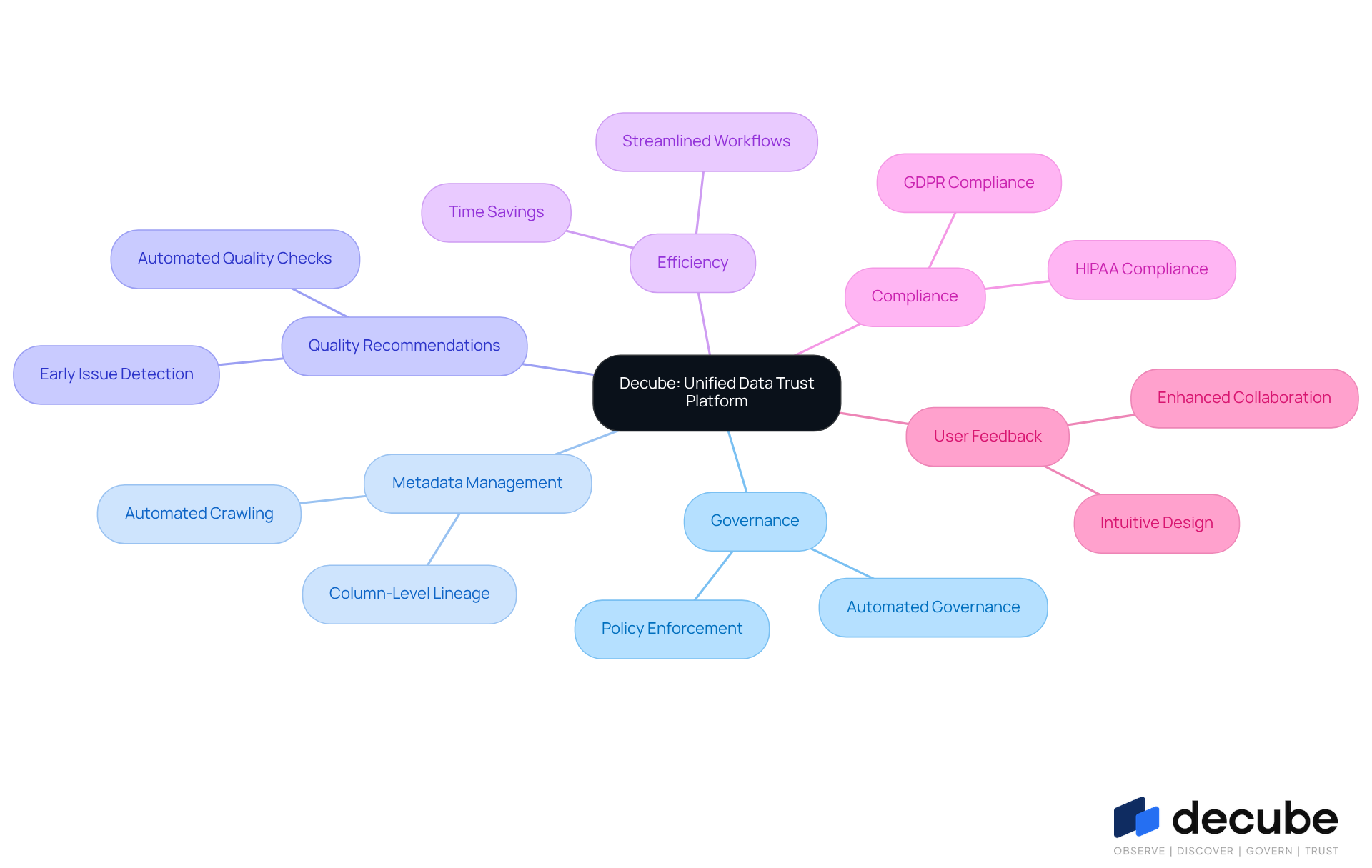
This mindmap illustrates how Decube enhances information governance. Start at the center with Decube, then explore the branches to see how different features contribute to effective governance, compliance, and user satisfaction.

DAMA-DMBOK: Comprehensive Data Management Framework

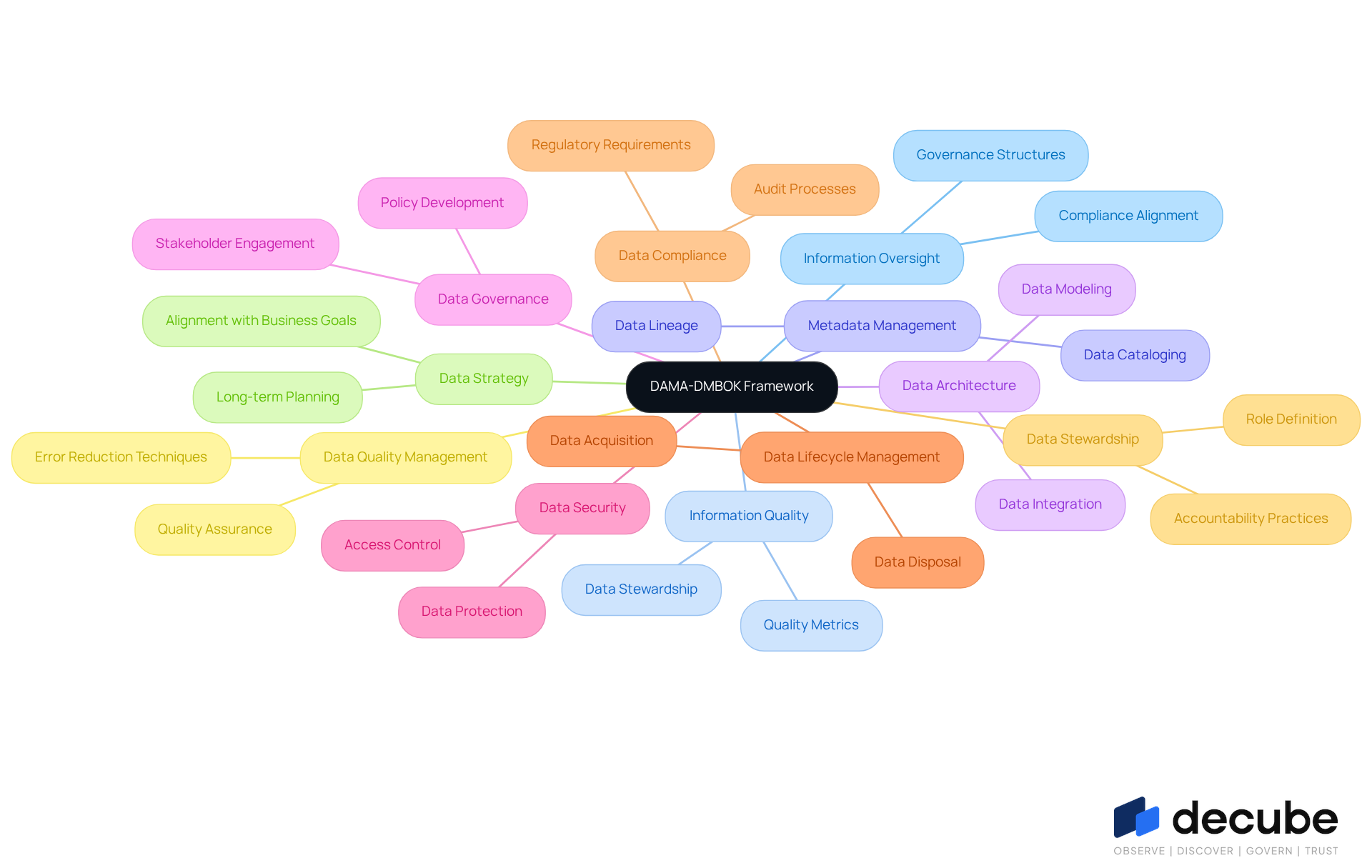
The DAMA-DMBOK framework serves as a cornerstone for effective information management, addressing critical areas essential for organizational success. It encompasses 11 vital knowledge areas, including information oversight, information quality, and metadata management. Following DAMA-DMBOK principles enables engineers to establish governance structures that ensure integrity, enhance compliance, and align with business objectives. This framework emphasizes the necessity of clearly defined roles, responsibilities, and processes, facilitating effective information management across the organization.

In the telecommunications industry, the influence of information stewardship on quality is particularly significant. Organizations that implement robust information stewardship practices experience measurable improvements in quality metrics, which are essential for sustaining competitive advantage and operational efficiency. Additionally, organizations using the DAMA-DMBOK framework have seen improvements in compliance rates, effectively navigating complex regulatory landscapes.

Optimal methods for engineers in 2026 involve incorporating DAMA-DMBOK principles into daily operations, promoting a culture of accountability, and employing quality management tools that align with the framework's standards. Real-world instances illustrate how organizations have effectively embraced DAMA-DMBOK for information management, providing data governance framework examples that lead to improved quality management and compliance outcomes. DAMA-DMBOK emphasizes data stewardship, which not only aids in regulatory compliance but also fosters a strategic view of data as a vital organizational asset. Ultimately, embracing DAMA-DMBOK principles transforms data into a strategic asset, driving both compliance and competitive advantage.

This mindmap starts with the DAMA-DMBOK framework at the center. Each branch represents a key knowledge area, and the sub-branches show important principles or practices related to that area. This structure helps you understand how different aspects of data management connect and contribute to organizational success.

COBIT: Aligning IT Governance with Business Objectives

COBIT serves as a vital framework that bridges the gap between IT management and business objectives, particularly in sectors like financial services and telecommunications. By providing a structured set of best practices and tools, COBIT enables organizations to effectively manage and govern their IT resources. For information engineers, the application of COBIT means ensuring that management practices are not only compliant but also strategically aligned with organizational objectives. This alignment is essential because it improves decision-making and increases the value derived from data assets.

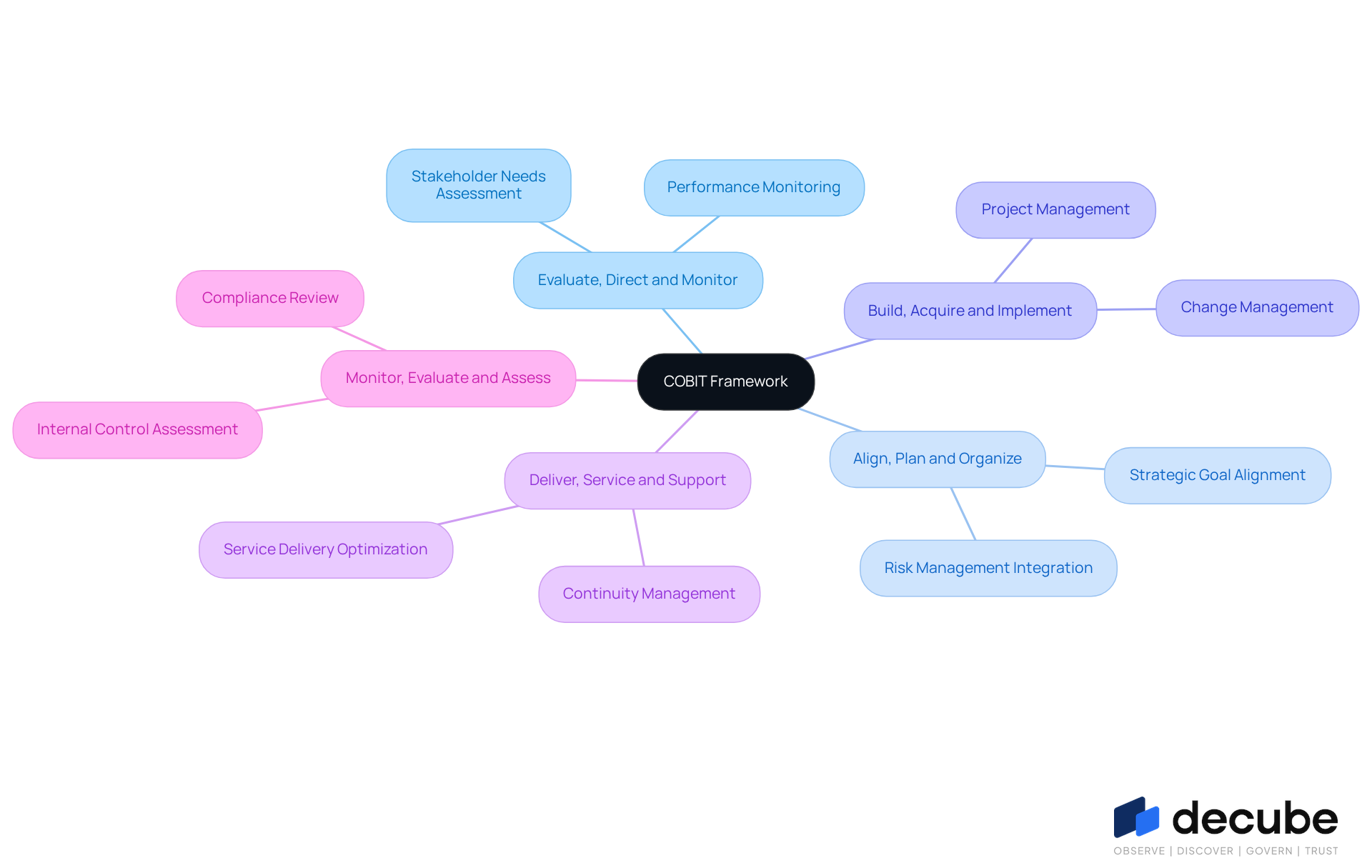
The influence of COBIT on IT oversight is profound, as it organizes oversight and management tasks into 40 objectives across five domains:

  1. Evaluate, Direct and Monitor
  2. Align, Plan and Organize
  3. Build, Acquire and Implement
  4. Deliver, Service and Support
  5. Monitor, Evaluate and Assess

This structured approach ensures that IT investments support strategic priorities, thereby enhancing stakeholder accountability and optimizing resource use.

Recent updates to COBIT emphasize the critical need for organizations to regularly reevaluate their management designs, enabling entities to adjust to evolving business landscapes and regulatory demands. For instance, the integration of DORA and NIS2 compliance requirements into COBIT objectives provides a framework for organizations to demonstrate compliance while managing risks effectively.

In this context, Decube emerges as a unified information trust platform that enhances observability, governance, and quality assurance. With features such as automated crawling for effortless metadata management and a strong emphasis on lineage, Decube guarantees that quality is upheld without the necessity for extensive manual intervention. This feature is particularly beneficial for engineers, streamlining workflows and building trust in information across teams. Moreover, Decube's adherence to GDPR, HIPAA, SOC 2, and ISO 27001 certifications offers crucial security guarantees, establishing it as a trustworthy option for entities in the financial services and telecommunications sectors. Customer testimonials showcase Decube's intuitive design and robust UI/UX, further underscoring its role in improving information management and observability. Incorporating Decube into information management strategies not only enhances data integrity but also positions organizations to navigate compliance challenges effectively.

The central node represents the COBIT framework, while the branches show the five key objectives. Each objective can have additional details that explain its importance and how it aligns with business goals. This layout helps visualize the relationship between IT governance and business objectives.

DCAM: Data Governance for Financial Services

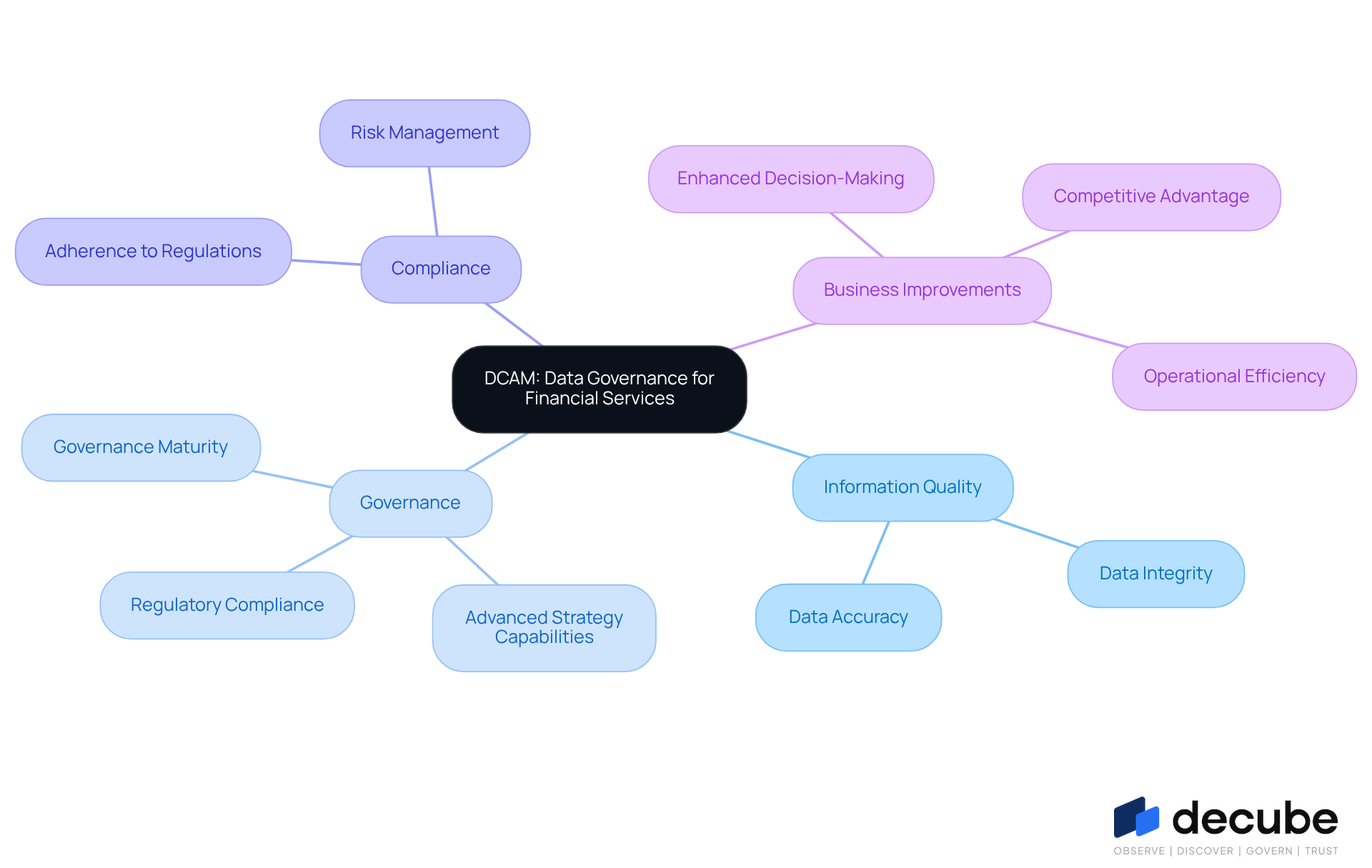
The Information Management Capability Assessment Model (DCAM) serves as a vital framework for the financial services sector, addressing the critical need for effective information management. Focusing on critical elements like information quality, governance, and compliance, DCAM empowers entities to effectively navigate stringent regulatory demands.

For information engineers, adopting DCAM means applying best practices that maintain integrity and support compliance with regulatory requirements. This structured approach not only simplifies compliance but also drives significant business improvements.

Recent findings suggest that entities employing DCAM report substantial enhancements in governance maturity, with 31% of firms attaining advanced strategy capabilities, highlighting the model's role in connecting AI ambitions and readiness.

Ultimately, the adoption of DCAM positions entities to not only meet regulatory standards but also to leverage their information management capabilities for strategic advantage.

The central node represents the DCAM framework, while the branches show critical elements and their benefits. Each color-coded branch helps you see how different aspects of information management connect and contribute to overall governance and compliance.

Data Quality Management Frameworks: Ensuring Reliable Governance

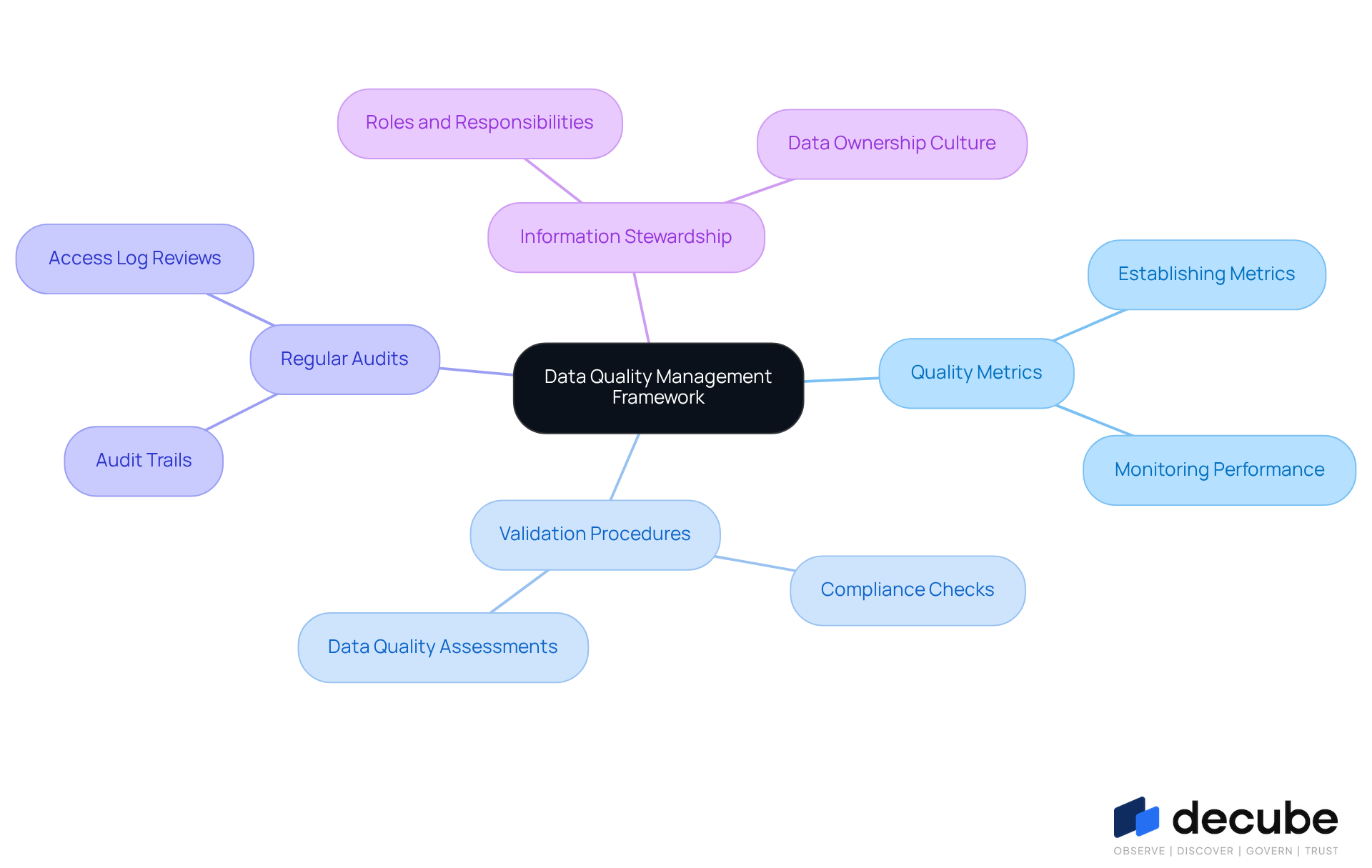
In an era where information quality is paramount, organizations must adopt effective quality management systems to navigate complex regulatory landscapes. Quality management systems offer crucial approaches for evaluating, overseeing, and improving information quality within organizations. These structures emphasize the importance of establishing quality metrics, executing validation procedures, and performing regular audits. For information engineers, adopting a robust quality management framework is vital to ensure that information remains accurate, complete, and reliable. This reliability is essential for efficient information management, as high-quality information supports informed decision-making and adherence to regulatory standards.

In 2024, more than 65% of information leaders prioritized information management over other issues, such as AI and information quality, highlighting its essential role in handling information efficiently amidst rising regulatory pressures. As organizations face increasing regulatory pressures, the challenge of prioritizing effective information management becomes more pronounced. Inadequate information quality can lead to significant financial losses, costing firms up to 12% of their income, while 60% to 73% of information often goes unutilized for strategic objectives. This highlights the need for strong oversight to enhance information usage.

Real-world examples illustrate the effect of structured methods within data governance framework examples. For instance, a clinical-stage pharmaceutical company utilized a Clinical Data Management System (CDMS) with admin-level access controls, enabling daily security monitoring and achieving a detection-to-action window of within 24 hours. This proactive approach ensured compliance and built trust in the organization’s information handling practices.

Organizations are recognizing that effective information stewardship is crucial for meeting regulatory requirements. Effective information stewardship involves assigning clear roles and responsibilities, which fosters a culture of accountability and collaboration. This is crucial for preserving high information quality and ensuring that management policies are executed effectively.

Ultimately, organizations that neglect information quality metrics risk not only compliance failures but also significant operational inefficiencies. The incorporation of information quality metrics within management structures is not merely a best practice; it is essential for entities striving to succeed in a metrics-driven environment. By prioritizing data quality and stewardship, entities can enhance their operational efficiency, ensure compliance, and ultimately drive better decision-making.

The central node represents the main framework, while the branches show the key components and their relationships. Each sub-branch provides more detail on specific actions or concepts related to data quality management.

AI Governance Framework: Managing Data in the Age of AI

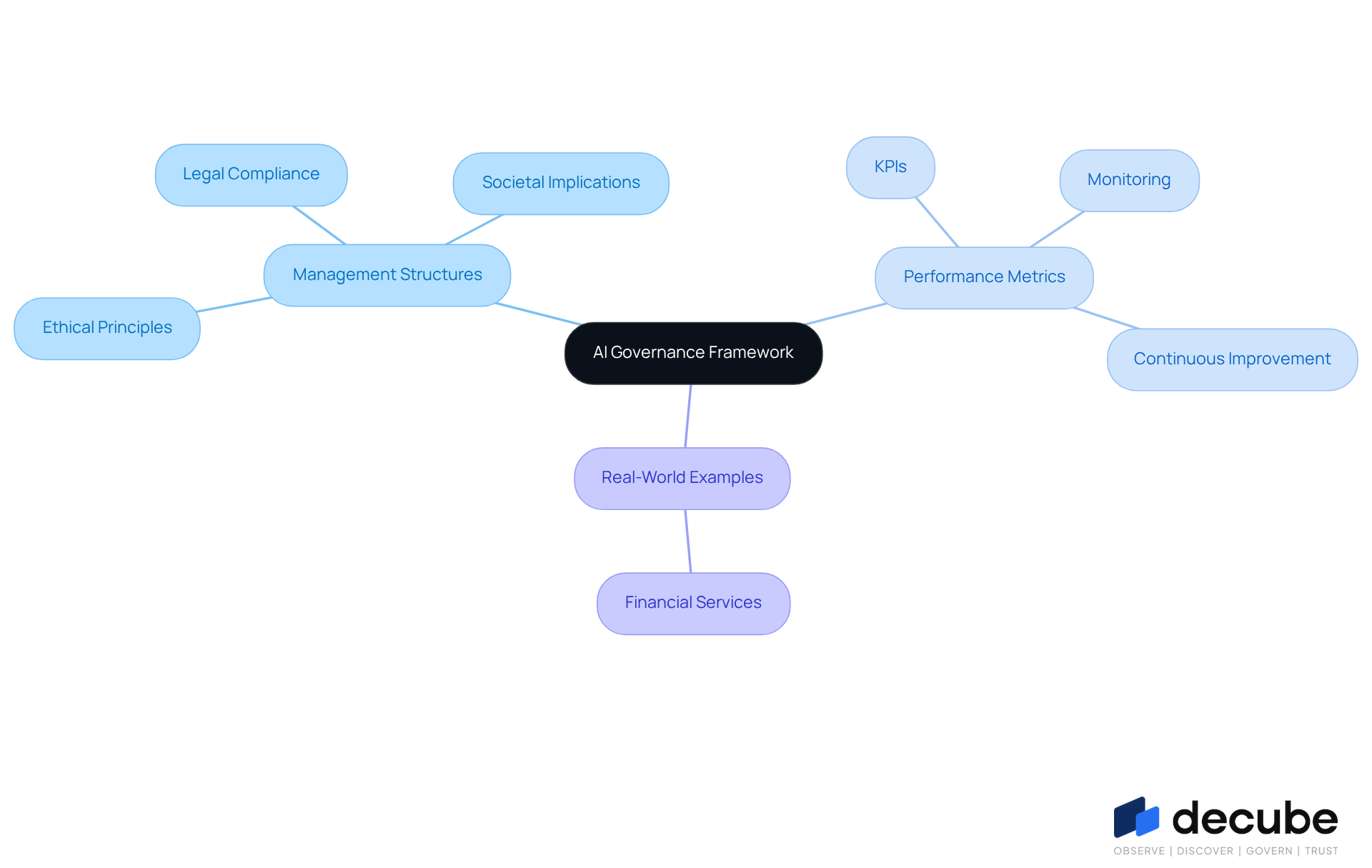
Establishing effective AI management structures is crucial for organizations leveraging artificial intelligence in their operations. These structures outline the principles necessary for addressing the ethical, legal, and societal implications of AI technologies. Information engineers must establish an AI oversight framework that guarantees the information used in AI models is accurate, unbiased, and compliant with regulations. This management is vital for maintaining trust in AI systems and ensuring they deliver value without compromising ethical standards.

Real-world examples demonstrate how aligning information management with business strategy can enhance operational efficiency. For instance, entities in the financial services industry have successfully incorporated performance metrics into their management frameworks, allowing them to monitor information quality and compliance efficiently. This alignment enhances regulatory compliance and cultivates a culture of accountability and ongoing improvement.

Performance metrics play a significant role in the success of information management initiatives. By establishing key performance indicators (KPIs), organizations can measure the effectiveness of their management strategies and make informed decisions. Frequent evaluations of these metrics assist in recognizing areas for improvement, ensuring that information management practices develop in accordance with business goals.

Recent updates to the PwC framework highlight the significance of information management performance metrics in driving organizational success. By concentrating on metrics that correspond with business objectives, companies can enhance their governance efforts, ultimately resulting in better quality, security, and compliance. This strategic approach not only reduces risks linked to information management but also improves the overall value obtained from information assets. Ultimately, organizations that prioritize effective information management will be better equipped to navigate the complexities of AI technologies.

This mindmap starts with the central idea of AI governance and branches out into key components. Each branch represents a crucial aspect of managing AI, showing how they relate to one another. Follow the branches to understand how effective management structures and performance metrics contribute to successful AI implementation.

Compliance Frameworks: Meeting Regulatory Requirements

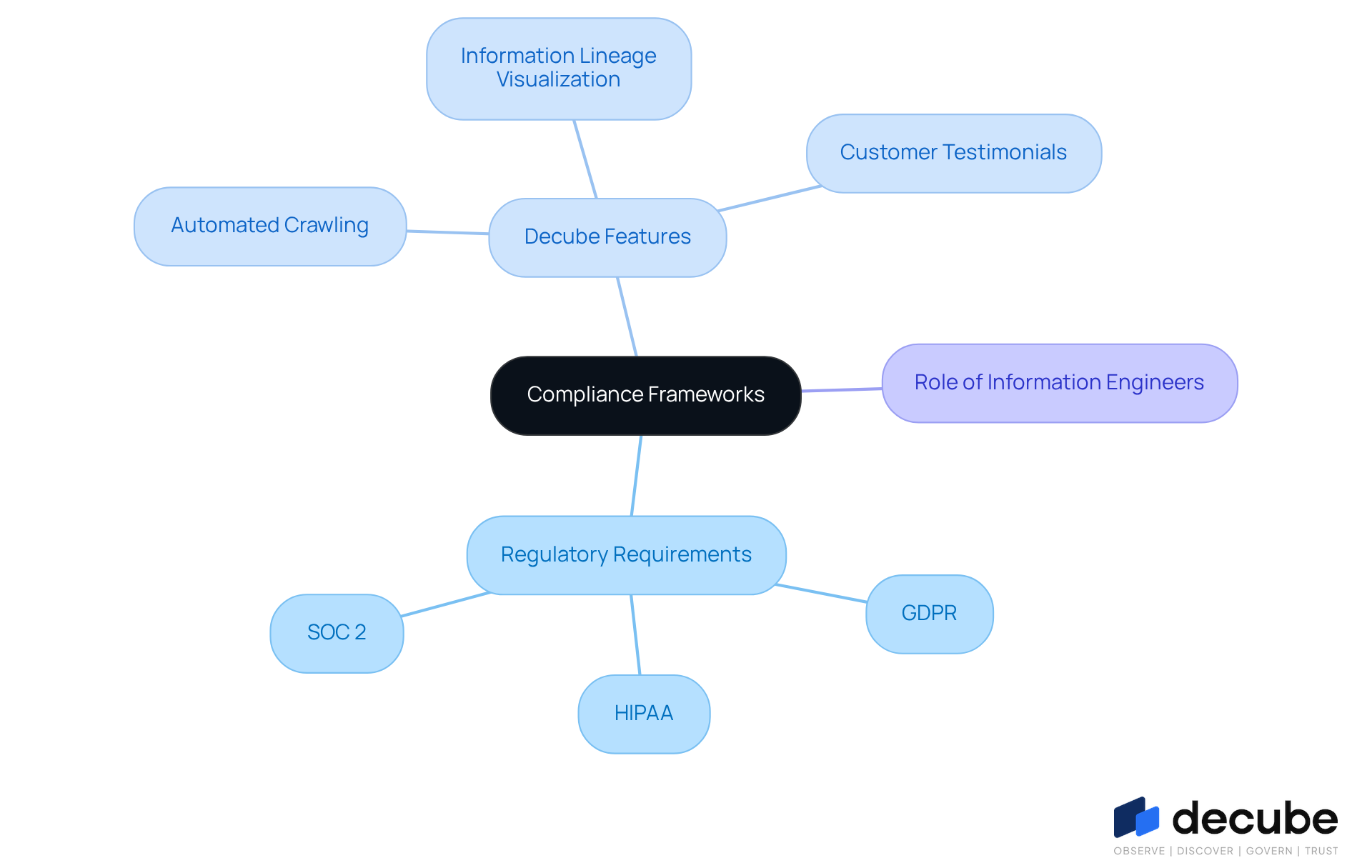
Navigating the complex landscape of legal and regulatory obligations poses significant challenges for organizations, particularly in information management. This is especially true in sectors such as finance, healthcare, and telecommunications, where information privacy and security are paramount. For information engineers, a thorough comprehension of compliance frameworks ensures that information management practices align with regulations such as GDPR, HIPAA, and SOC 2. This alignment mitigates risks and enhances the organization's reputation and trustworthiness.

Decube offers a unified trust platform that improves observability, governance, and quality assurance, positioning it as a critical resource for information management professionals. Its automated crawling feature ensures that metadata is continuously updated without manual intervention, streamlining the information management process. Furthermore, Decube's end-to-end information lineage visualization enables teams to monitor flow across components, promoting transparency and collaboration.

Real-world examples demonstrate the impact of Decube's management tools on information quality. Organizations have effectively employed Decube to enhance their security posture and simplify information management processes, showcasing the concrete advantages of incorporating a comprehensive information oversight solution. Customer testimonials emphasize Decube's intuitive design and robust UI/UX, which greatly enhance workflows and information trust.

As the demand for efficient information management escalates, engineers play a pivotal role in implementing these compliance structures. By leveraging Decube's capabilities, organizations can transform compliance challenges into opportunities for enhanced operational integrity and stakeholder trust.

This mindmap starts with the central idea of compliance frameworks and branches out to show related topics. Each branch represents a key area, such as specific regulations or features of Decube, helping you see how they connect and support effective information management.

Data Stewardship Frameworks: Ensuring Accountability and Ownership

Effective information stewardship structures are crucial for defining accountability in information management within organizations. These structures clearly outline the roles and responsibilities of information stewards, who are vital for ensuring quality, compliance, and accessibility. In 2026, fostering accountability in information management is increasingly essential, particularly as entities face rising regulatory pressures and the complexities of information oversight, including adherence to standards such as GDPR, HIPAA, SOC 2, and ISO 27001.

Establishing a strong stewardship framework mitigates risks and empowers teams to make informed decisions based on reliable information. For example, organizations such as Naranja X have effectively expanded their information stewardship initiatives, enhancing information literacy and ensuring that a substantial portion of their information lake is managed. This proactive approach to information stewardship significantly enhances compliance and quality, as evidenced by case studies from leading organizations, showcasing the effectiveness of assigning clear accountability in management.

With Decube's unified platform for information observability and management, engineers can leverage its intuitive design to streamline workflows and enhance trust in the information. The platform's lineage feature offers clarity in information pipelines, ensuring that information remains precise and consistent, which is vital for effective stewardship. Feedback from clients highlights how Decube enhances information governance and observability, rendering it a valuable resource for entities seeking to enhance their management practices.

Ultimately, the integration of robust stewardship frameworks can transform how organizations approach information governance, leading to enhanced operational efficiency and compliance.

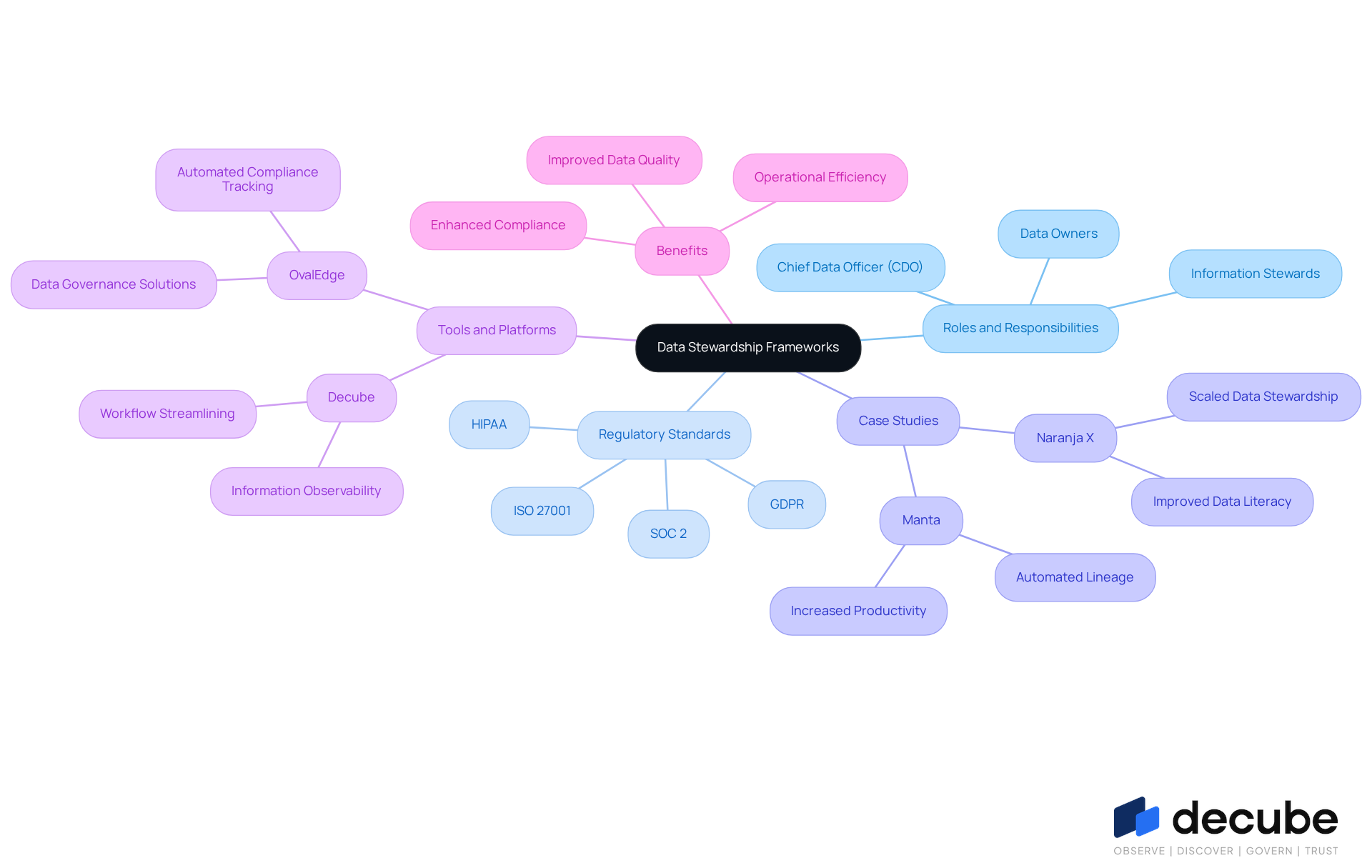
This mindmap starts with the main idea of data stewardship at the center. From there, you can explore different branches that represent key areas of focus, such as roles, regulations, and tools. Each branch can lead to more detailed information, helping you understand how everything connects in the realm of information management.

Data Lineage Frameworks: Ensuring Transparency in Data Flow

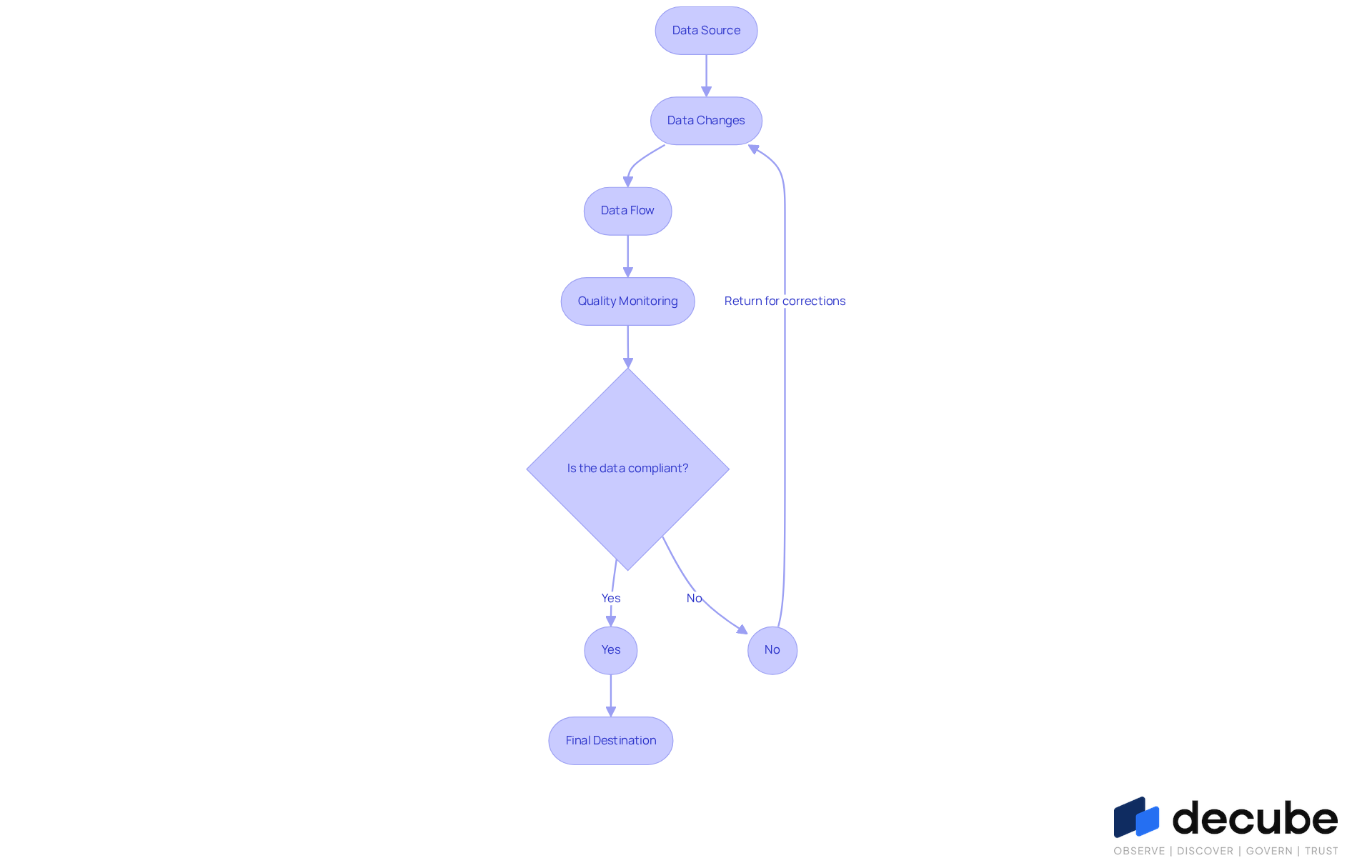
Information lineage structures offer a systematic method for documenting and visualizing the flow of information throughout its lifecycle. These structures enable organizations to track the sources of information, comprehend its changes, and determine its final destinations. For engineers, implementing a lineage framework is crucial for fostering transparency and accountability in management. This transparency helps achieve regulatory compliance and improves information quality by allowing teams to quickly identify and resolve issues in information flows.

Decube effectively uses automated lineage tracking, with a design that builds trust in information and simplifies workflows. With features like end-to-end information lineage visualization and automated quality monitoring, Decube enables organizations to quickly trace information flows, identify root causes, and assess downstream impacts, ensuring compliance and operational efficiency. Firms in the financial industry are progressively embracing active management frameworks that incorporate information lineage into their workflows, fostering collaboration among teams and improving trust in information handling practices.

Automation significantly enhances information management practices. By automating lineage tracking, Decube minimizes manual errors and enhances the speed of issue resolution, resulting in a more agile information management environment. Studies show that entities utilizing AI-powered information management solutions can attain a 30% decrease in the time needed for regulatory compliance procedures. As Aryan Sharma observes, contemporary management structures depend significantly on automation and integration with information platforms, transforming oversight into an operational aspect instead of a distinct effort. This shift not only streamlines processes but also reinforces the importance of transparency in information flow, ultimately driving better decision-making and accountability across the organization. Moreover, by 2026, it is anticipated that over 60% of information management decisions will be completely automated, emphasizing the future trajectory of information oversight. Furthermore, Decube's adherence to GDPR, HIPAA, SOC 2, and ISO 27001 certifications further reinforces its trustworthiness in information management.

This flowchart shows how data moves from its source through various stages until it reaches its final destination. Each box represents a step in the process, and the arrows indicate the direction of data flow. Decision points help identify compliance checks along the way, ensuring that the data management process is transparent and accountable.

Custom Data Governance Frameworks: Tailoring to Organizational Needs

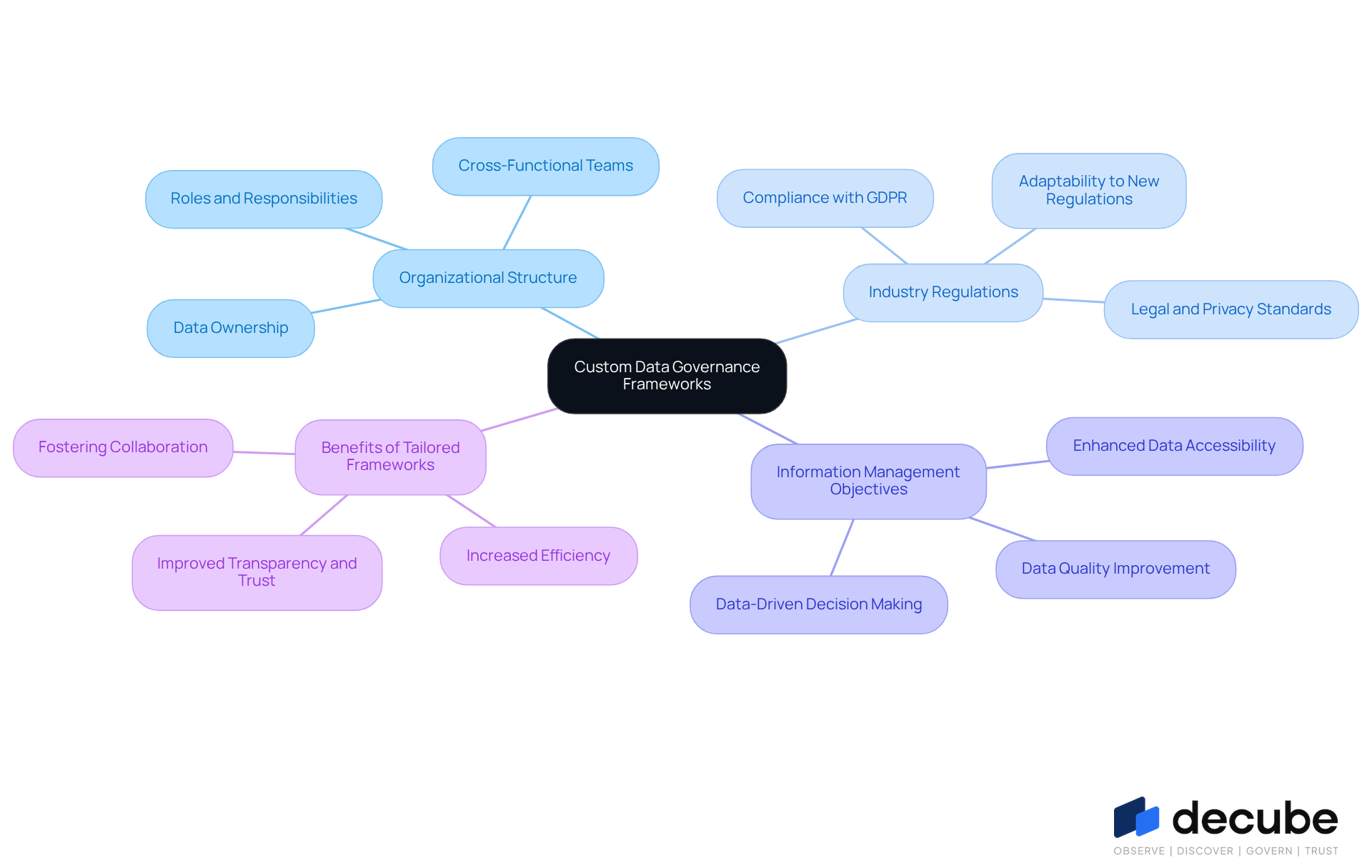
Tailored information management structures are crucial for organizations aiming to navigate complex operational landscapes. These systems must account for various factors, including:

  1. Organizational structure
  2. Industry regulations
  3. Specific information management objectives

For information engineers, creating a customized oversight framework guarantees alignment with the entity's strategic goals while tackling specific information challenges. This tailored approach not only improves the effectiveness of management practices but also fosters an environment that prioritizes data-driven decision-making.

Adaptability in management is essential; organizations that adopt agile methodologies can react quickly to evolving information environments, enhancing collaboration and efficiency. Industry specialists emphasize that effective information management can transform disorder into clarity, fostering transparency and trust in information.

The iterative processes inherent in agile management allow for continuous refinement, ensuring that oversight structures remain relevant and impactful. By prioritizing tailored data governance framework examples, organizations can significantly enhance their data management effectiveness, ultimately driving better business outcomes.

This mindmap starts with the main idea of tailored data governance frameworks at the center. Each branch represents a key factor or benefit, helping you see how they connect and contribute to effective information management.

Conclusion

In an era of increasing regulatory scrutiny, organizations must prioritize robust data governance frameworks to thrive. The frameworks discussed in this article, including Decube, DAMA-DMBOK, COBIT, and DCAM, provide essential strategies and tools tailored for data engineers in the financial services and telecommunications sectors. Adopting these frameworks enables organizations to significantly improve their information management practices, ensuring compliance with standards such as GDPR, HIPAA, SOC 2, and ISO 27001, while also fostering a culture of accountability and trust.

Key insights from the article highlight how frameworks like Decube streamline workflows through its unified data trust platform, which integrates cataloging, lineage, quality, and observability without the need for third-party tools. The DAMA-DMBOK framework emphasizes the significance of clearly defined roles and responsibilities, while COBIT aligns IT governance with business objectives, enhancing decision-making and resource optimization. Furthermore, the DCAM framework empowers financial services organizations to meet stringent regulatory demands, driving improvements in governance maturity and strategic capabilities.

In conclusion, the adoption of tailored data governance frameworks is a critical necessity for organizations aiming to excel in today's complex regulatory environment. Focusing on effective information management allows organizations to transform compliance challenges into opportunities for enhanced operational integrity and stakeholder trust. Ultimately, the strategic implementation of these frameworks can redefine an organization's approach to compliance and operational excellence.

Frequently Asked Questions

What is Decube and how does it contribute to data governance?

Decube is a comprehensive data governance framework designed to manage unstructured data effectively. It provides high-fidelity context essential for management through advanced metadata management, which includes automated suggestions and real-time monitoring.

What are the key features of Decube?

Key features of Decube include:

  • Column-level lineage for precise tracing of information flow.
  • Pipeline observability to identify bottlenecks.
  • A glossary that connects information with business terminology.

How does Decube ensure compliance with industry standards?

Decube enhances information management by ensuring compliance with standards such as SOC 2 and GDPR. This guarantees that information remains precise, consistent, and secure, which is critical for organizations, especially in regulated sectors like financial services.

What benefits do users report from using Decube?

Users have praised Decube for its intuitive design and robust UI/UX, noting that it effectively streamlines workflows and builds trust in information management. It has been recognized for improving information quality and aiding in better business decisions.

What is the DAMA-DMBOK framework and its significance?

The DAMA-DMBOK framework provides best practices for effective information management, focusing on areas like information quality management, stewardship, and compliance. It emphasizes the importance of defined roles, robust policies, and maintaining information integrity.

How does the DAMA-DMBOK framework impact decision-making in organizations?

Organizations that follow DAMA-DMBOK principles experience better compliance and operational efficiencies, including a 25% faster decision-making process. This is particularly beneficial in industries facing regulatory scrutiny, such as telecommunications.

What role does COBIT play in IT governance?

COBIT serves as a framework that integrates IT management with information governance. It provides guidelines for managing IT resources efficiently, ensuring that information management aligns with organizational goals and enhances risk management.

How does COBIT help organizations in the financial services sector?

In the financial services sector, COBIT helps organizations customize management systems to meet specific regulatory and risk oversight challenges, leading to improved information quality and security.

What are the benefits of implementing a structured approach to information management?

Implementing a structured approach, such as those outlined in DAMA-DMBOK and COBIT, helps organizations maintain compliance, enhance information quality, and improve operational efficiencies, ultimately transforming data into a strategic asset.

How does Decube integrate with the principles of DAMA-DMBOK and COBIT?

Decube aligns with the principles of DAMA-DMBOK and COBIT by offering features like automated monitoring and lineage visualization, which enhance information quality and oversight, ensuring compliance with regulatory standards.

List of Sources

  1. Decube: A Unified Data Trust Platform for Enhanced Governance
    • Why metadata management now defines AI scale - SiliconANGLE (https://siliconangle.com/2026/01/23/metadata-management-ai-scale-challenges-futureofdataplatforms)
    • Data Governance in the AI Era: 10 Shifts Redefining Data, Institutions, and Practice (https://sverhulst.medium.com/data-governance-in-the-ai-era-10-shifts-redefining-data-institutions-and-practice-69296b808683)
    • The 20 Biggest AI Governance Statistics and Trends of 2025 (https://knostic.ai/blog/ai-governance-statistics)
    • 7 Best Data Governance Tools for Reliable Data Quality | Decube (https://decube.io/post/7-best-data-governance-tools-for-reliable-data-quality)
    • What “Good” Data Governance Looks Like in 2026 (https://acceldata.io/blog/what-modern-data-governance-actually-looks-like-in-2026)
    • Quotes Related to Data and Data Governance (https://blog.idatainc.com/quotes-related-to-data-and-data-governance)
  2. DAMA-DMBOK: Comprehensive Data Management Framework
    • DAMA-DMBOK® 3.0 Project (https://dama.org/dama-dmbok-3-0-project)
    • Aligning DAMA-DMBOK & DCAM®: (R)Evolution in the Industry? - Data Crossroads (https://datacrossroads.nl/2025/07/09/aligning-dama-dmbok-dcam-revolution-in-the-industry)
    • DAMA-DMBOK by DAMA International | Summary, Audio, Quotes, FAQ (https://sobrief.com/books/dama-dmbok)
    • Data Governance Statistics | 2026 Edition – Gitnux (https://gitnux.org/data-governance-statistics)
    • DAMA International launches DMBOK 3.0 with community-driven updates | Martin Whiley posted on the topic | LinkedIn (https://linkedin.com/posts/martin-whiley-a15929149_the-global-data-management-community-dama-dmbok-activity-7407017138978189313-D0VF)
    • DAMA-DMBOK Explained: Data Management Framework | Snowflake (https://snowflake.com/en/data-governance/frameworks/dama-dmbok)
  3. COBIT: Aligning IT Governance with Business Objectives
    • COBIT guide: Principles, enablers, and IT governance explained (https://optro.ai/blog/cobit)
    • What Is the COBIT Framework? Governance Guide | Snowflake (https://snowflake.com/en/data-governance/frameworks/cobit)
    • The Ultimate Guide to COBIT for 2026 (https://metricstream.com/learn/cobit-ultimate-guide.html)
    • Future Trends in IT Governance: Evolution of COBIT Framework (https://icertglobal.com/blog/future-trends-in-it-governance-the-evolution-of-cobit-blog)
  4. DCAM: Data Governance for Financial Services
    • 2026 Global Data Management Benchmark Report Released by EDM (https://digitalitnews.com/2026-global-data-management-benchmark-report-released-by-edm)
    • EDM Association Benchmark Reveals Growing Gap Between Data Management Capability and AI Implementation (https://globenewswire.com/news-release/2026/05/19/3297382/0/en/edm-association-benchmark-reveals-growing-gap-between-data-management-capability-and-ai-implementation.html)
    • Understanding Data Governance Framework Adoption Across Industries (Preliminary Findings) (https://medium.com/my-column-has-nulls/understanding-data-governance-framework-adoption-across-industries-preliminary-findings-fabebd0dbf72)
    • Announcing DCAM v3: Meet the new standard for your data - EDM Council (https://edmcouncil.org/announcement/announcing-dcam-v3-meet-the-new-standard-for-your-data)
    • DAMA-DMBOK2 vs DCAM®2.2: Usage Statistics - Data Crossroads (https://datacrossroads.nl/2021/03/31/dama-dmbok2-vs-dcam-2-2-usage-statistics)
    • EDM Association Benchmark Reveals Growing Gap Between Data Management Capability and AI Implementation - EDM Council (https://edmcouncil.org/announcement/edm-association-benchmark-reveals-growing-gap-between-data-management-capability-and-ai-implementation)
    • Data Management - DCAM - EDM Council (https://edmcouncil.org/frameworks/dcam)
  5. Data Quality Management Frameworks: Ensuring Reliable Governance
    • New Global Research Points to Lack of Data Quality and Governance as Major Obstacles to AI Readiness (https://prnewswire.com/news-releases/new-global-research-points-to-lack-of-data-quality-and-governance-as-major-obstacles-to-ai-readiness-302251068.html)
    • Achieving Data Quality and Regulatory Compliance Through Robust Governance (https://usdm.com/resources/blogs/achieving-data-governance)
    • Data Governance Statistics And Facts (2025): Emerging Technologies, Challenges And Adoption, AI, ROI, and Data Quality Insights (https://electroiq.com/stats/data-governance)
    • Quotes Related to Data and Data Governance (https://blog.idatainc.com/quotes-related-to-data-and-data-governance)
    • DGI Data Governance Framework | The Data Governance Institute (https://datagovernance.com/the-dgi-data-governance-framework)
    • A Continual Quest for Improving Data Quality | U.S. Bureau of Economic Analysis (BEA) (https://bea.gov/news/blog/2026-03-16/continual-quest-improving-data-quality)
  6. AI Governance Framework: Managing Data in the Age of AI
    • Data Governance Metrics: How to Measure Success - Dataversity (https://dataversity.net/articles/data-governance-metrics-how-to-measure-success)
    • How to Measure Success with Data Governance Metrics (https://semarchy.com/blog/how-to-measure-success-with-data-governance-metrics)
    • Data Governance Performance Metrics: Key KPIs | Atlan (https://atlan.com/know/data-governance/performance-metrics)
    • Why data governance is the cornerstone of trustworthy AI in 2026 (https://strategy.com/it/software/blog/why-data-governance-is-the-cornerstone-of-trustworthy-ai-in-2026)
    • PwC Enterprise Data Governance Framework (https://dr-alvin-ang.medium.com/pwc-enterprise-data-governance-framework-13b3d6484333)
  7. Compliance Frameworks: Meeting Regulatory Requirements
    • Microsoft releases Azure update with text analytics for health capabilities (https://healthcareitnews.com/news/microsoft-releases-azure-update-text-analytics-health-capabilities)
    • How Many Companies Use Cloud Computing? [Key Stats] (https://edgedelta.com/company/knowledge-center/how-many-companies-use-cloud-computing)
    • What's new in Microsoft Purview (https://learn.microsoft.com/en-us/purview/whats-new)
    • 3 things leaders need to know from Microsoft Build 2026 | Microsoft Azure Blog (https://azure.microsoft.com/en-us/blog/3-things-leaders-need-to-know-from-microsoft-build-2026)
    • Cloud Governance: a framework for success – Microsoft Pulse (https://pulse.microsoft.com/en/azure-cloud-governance)
  8. Data Stewardship Frameworks: Ensuring Accountability and Ownership
    • The 20 Biggest AI Governance Statistics and Trends of 2025 (https://knostic.ai/blog/ai-governance-statistics)
    • Data Governance & Compliance Framework: Best Practices 2026 (https://ovaledge.com/blog/data-governance-and-compliance)
    • 6 benefits of data lineage for financial services | IBM (https://ibm.com/think/topics/data-lineage-financial-services)
    • Top Data Governance Frameworks in 2026 | EM360Tech (https://em360tech.com/top-10/top-data-governance-frameworks)
    • What “Good” Data Governance Looks Like in 2026 (https://acceldata.io/blog/what-modern-data-governance-actually-looks-like-in-2026)
    • Quotes Related to Data and Data Governance (https://blog.idatainc.com/quotes-related-to-data-and-data-governance)
  9. Data Lineage Frameworks: Ensuring Transparency in Data Flow
    • BigID & Atlan Introduce the First Unified Structured & Unstructured Data Catalog for AI Governance (https://prnewswire.com/news-releases/bigid--atlan-introduce-the-first-unified-structured--unstructured-data-catalog-for-ai-governance-302708291.html)
    • How AI is Transforming Data Governance: Automation, Metadata, and Beyond (https://linkedin.com/pulse/how-ai-transforming-data-governance-automation-metadata-manish-sinha-rslyc)
    • Automated Data Governance: Benefits & Practices - OvalEdge (https://ovaledge.com/blog/automated-data-governance)
    • Quotes Related to Data and Data Governance (https://blog.idatainc.com/quotes-related-to-data-and-data-governance)
    • ThirdEye Data: Atlan Data Governance & Solutions (https://thirdeyedata.ai/data-management-and-governance/using-atlan-for-data-governance)
    • What “Good” Data Governance Looks Like in 2026 (https://acceldata.io/blog/what-modern-data-governance-actually-looks-like-in-2026)
  10. Custom Data Governance Frameworks: Tailoring to Organizational Needs
  • Agile Data Governance: Are You Drowning in Rigidity or Thriving in the Data Stream? (https://altr.com/resource/agile-data-governance)
  • A Modern Operating Model for Agile Data Governance – First San Francisco Partners (https://firstsanfranciscopartners.com/blog/modern-operating-model-agile-data-governance)
  • Agile Data Governance: The Downfall of a Top-Down Approach (https://data.world/blog/what-is-agile-data-governance)
  • Walking the Tightrope: How to Use Agile to Succeed With Data Governance Strategy (https://centricconsulting.com/blog/walking-the-tightrope-how-to-use-agile-to-succeed-with-data-governance-strategy)
  • Agile Data Governance Model: Components, Best Practices (https://atlan.com/agile-data-governance-model)
  • Data Governance Statistics And Facts (2025): Emerging Technologies, Challenges And Adoption, AI, ROI, and Data Quality Insights (https://electroiq.com/stats/data-governance)
  • The World Data Organization: A New Player in Global Data Governance – What Businesses Need to Know | JD Supra (https://jdsupra.com/legalnews/the-world-data-organization-a-new-1957629)
What is the difference between a context layer and a semantic layer?
A semantic layer standardizes how metrics are defined and calculated so every analyst and BI tool uses the same numbers. A context layer encodes governance rules, data lineage, quality signals, and organizational knowledge so AI agents can make safe, autonomous decisions. The semantic layer is for human-facing analytics. The context layer is for AI-facing autonomy.
Can I use a semantic layer without a context layer?
Yes - and most organizations do today. If your primary consumers are human analysts using BI tools, a semantic layer alone is sufficient. The context layer becomes essential when you introduce AI agents that need to understand not just what a metric means but whether and how they are allowed to use it.
Is a context layer the same as a data catalog?
No. A data catalog is a component of a context layer. The catalog inventories data assets and stores metadata. The context layer activates that metadata by delivering it to AI agents at query time through APIs and MCP connections. Modern platforms like Atlan extend catalog functionality into full context layer infrastructure.
Which tool implements a context layer?
Purpose-built context layer platforms include Decube, which combines catalog, lineage, quality, and governance into a metadata layer that delivers context to AI agents via MCP. You can also build a context layer on custom infrastructure using a vector database (for semantic search), a knowledge graph
How long does it take to implement a context layer?
Most enterprise context layer implementations take 8–16 weeks when using a purpose-built platform like Atlan. Building from scratch on custom infrastructure typically takes 6–12 months. The timeline depends heavily on how much governance metadata already exists and how many data sources need to be connected.
What is Data Context?
Data Context is the information that explains what data means, where it comes from, how it is transformed, whether it can be trusted, and how it should be used. It combines metadata, lineage, data quality, and governance so people and systems can confidently use data for analytics, reporting, and AI.
How is Data Context different from metadata?
Metadata describes data, while Data Context makes data usable and trustworthy. Metadata provides definitions, ownership, and technical details. Data Context extends this by adding lineage, quality signals, and governance rules, creating a complete, operational understanding of data.
Why is Data Context important for AI?
AI systems require Data Context to interpret data correctly, safely, and reliably. Without context, AI models may misunderstand metrics, use stale or incorrect data, or expose sensitive information. Data Context ensures AI uses trusted, well-defined, and policy-compliant data.
How does data lineage contribute to Data Context?
Data lineage provides visibility into how data flows and transforms across systems. It shows upstream sources, downstream dependencies, and transformation logic, enabling impact analysis, root-cause investigation, and confidence in reported numbers.
How do organizations build Data Context in practice?
Organizations build Data Context by unifying metadata, lineage, observability, and governance into a single operational layer. This includes defining business meaning, capturing end-to-end lineage, monitoring data quality, and enforcing usage policies directly within data workflows.
What is Context Engineering?
Context Engineering is the practice of designing and operationalizing business meaning, data lineage, quality signals, ownership, and policy constraints so that both humans and AI systems can reliably understand and act on enterprise data. Unlike traditional metadata management, Context Engineering focuses on decision-grade context that can be consumed programmatically by AI agents in real time.
How is Context Engineering different from prompt engineering?
Prompt engineering focuses on how questions are phrased for an AI model, while Context Engineering focuses on what the AI system already knows before a question is asked. In enterprise environments, context includes data definitions, lineage, quality, and usage constraints—making Context Engineering foundational for trustworthy and scalable Agentic AI.
Why is Context Engineering critical for Agentic AI?
Agentic AI systems reason, decide, and act autonomously across multiple systems. Without engineered context—such as trusted data meaning, lineage, and real-time quality signals—agents cannot assess risk or impact correctly. Context Engineering ensures AI agents act safely, explain decisions, and know when to pause or escalate.
What are the core components of Context Engineering?
The four core components of Context Engineering are: Semantic context (business meaning and definitions) Lineage context (end-to-end data flow and dependencies) Operational context (data quality and reliability signals) Policy context (privacy, compliance, and usage constraints) Together, these form a unified context layer that supports enterprise decision-making and AI automation
How should enterprises prepare for Context Engineering?
Enterprises should follow a phased approach: Inventory critical data and trust gaps Unify metadata, lineage, quality, and policy into a single context layer Expose context through APIs for AI agent consumption By 2026, this foundation will be essential for deploying Agentic AI at scale with confidence and auditability.
How do you measure the ROI of a data catalog?
ROI is measured by comparing the quantifiable benefits (such as reduced data search time, fewer data quality issues, and lower compliance effort) against the total costs (implementation, licensing, and support). Typical metrics include time savings, productivity gains, and compliance cost reduction.
What is a data catalog and why is it important for ROI?
A data catalog is a centralized inventory of data assets enriched with metadata that helps users find, understand, and trust data across an organization. It improves data discovery, reduces search time, and enhances collaboration — all of which contribute to measurable ROI by cutting operational costs and accelerating insights.
How quickly can businesses see ROI after implementing a data catalog?
Time-to-value varies with deployment and adoption, but many organizations begin seeing measurable improvements in days to months, especially through faster data discovery and reduced compliance effort. Early wins in these areas can quickly justify the investment.
What factors should you include when calculating the ROI of a data catalog?
When calculating ROI, include: Implementation and training costs Recurring maintenance and licensing fees Savings from reduced data search and rework Compliance cost reductions Productivity and decision-making improvements This ensures a holistic view of both costs and benefits.
How does a data catalog support data governance and compliance ROI?
A data catalog enhances governance by classifying data, enforcing rules, and providing transparency. This reduces regulatory risk and compliance effort, leading to direct cost savings and stronger data trust.
What is data lineage?
Data lineage shows where data comes from, how it moves, and how it changes across systems. It helps teams understand the full journey of data—from source to final reports or AI models.
Why is data lineage important for modern data teams?
Data lineage builds trust in data by making it transparent and explainable. It helps teams troubleshoot issues faster, assess impact before changes, meet compliance requirements, and confidently use data for analytics and AI.
What are the different types of data lineage?
Common types of data lineage include: Technical lineage – Tracks data movement at table and column level. Business lineage – Connects data to business definitions and metrics. Operational lineage – Shows how pipelines and jobs process data. End-to-end lineage – Combines all of the above across systems.
Is data lineage only useful for compliance?
No. While data lineage is critical for audits and regulatory compliance, it is equally valuable for debugging data issues, impact analysis, cost optimization, and AI readiness.
How does data lineage help with data quality?
Data lineage helps identify where data quality issues originate and which reports or dashboards are affected. This reduces time spent on root-cause analysis and improves accountability across data teams.
What is Metadata Management?
Metadata management involves the management and organization of data about data to enhance data governance, data asset quality, and compliance.
What are the key points of Metadata Management?
Metadata management involves defining a metadata strategy, establishing roles and policies, choosing the right metadata management tool, and maintaining an ongoing program.
How does Metadata Management work?
Metadata management is essential for improving data quality and relevance, utilizing metadata management tools, and driving digital transformation.
Why is Metadata Management important for businesses?
Metadata management is important for better data quality, usability, data insights, compliance adherence, and improved accuracy in data cataloging.
How should companies evolve their approach to Metadata Management?
Companies should manage all types of metadata across different environments, leverage intelligent methods, and follow best practices to maximize data investments.
What is a data definition example?
A data definition example could be: “Customer: a person or entity that has made at least one purchase within the past year.” It clearly sets business meaning and inclusion criteria.
Why is data definition important in data governance?
It ensures everyone interprets data consistently, reducing ambiguity and improving compliance, reporting, and collaboration.
Who should own data definitions?
Ownership should be shared between business domain experts (for context) and data stewards (for technical accuracy).
How often should data definitions be reviewed?
Ideally quarterly or whenever there’s a structural change in business logic, data models, or product offerings.
What’s the difference between data definition and data catalog?
A data catalog inventories data assets; data definition explains what those assets mean. Combined, they create full visibility and trust.
Why is Data Lineage important for businesses?
Data Lineage provides transparency and trust in your data ecosystem. It helps organizations ensure data accuracy, simplify root-cause analysis during data quality issues, and maintain compliance with regulations like GDPR or SOX. By understanding data flows, teams can make faster, more reliable decisions and improve overall data governance.
What are the key components of Data Lineage?
The main components of Data Lineage include: Data Sources: Where the data originates (databases, APIs, files). Transformations: How data is processed or modified. Data Pipelines: The tools or systems that move data. Destinations: Where the data is stored or consumed (dashboards, reports, models). Metadata: The contextual details that describe each step in the data’s lifecycle.
How does Data Lineage support Data Governance and AI readiness?
Data Lineage acts as the foundation for strong data governance by providing visibility into data ownership, transformation logic, and usage. For AI initiatives, lineage ensures that models are trained on accurate and traceable data, making AI outputs more explainable and trustworthy. Platforms like Decube’s Data Trust Platform unify lineage with data quality and metadata management to help enterprises achieve AI readiness.
What tools are commonly used for Data Lineage?
Several tools help automate and visualize data lineage, such as Decube, Atlan, Alation, Collibra, and OpenLineage. These tools connect to data warehouses, ETL pipelines, and BI tools to automatically map relationships between datasets — saving time and reducing manual effort.
What is Data Lineage?
Data Lineage is the process of tracking how data moves and transforms across an organization — from its origin to its final destination. It shows where data comes from, how it changes through different systems or pipelines, and where it ends up being used. In short, data lineage helps you visualize the journey of your data.
What does “data context” mean?
Data context refers to the semantic, structural, and business information that surrounds raw data. It explains what data means, where it comes from, who owns it, and how it should be used.
What is a centralized LLM framework?
It’s an enterprise-wide system where all departments access AI through a shared platform, equipped with guardrails, context layers, and multimodal capabilities.
What are guardrails in AI?
Guardrails are controls—policies, access restrictions, and compliance checks—that ensure AI outputs are secure, ethical, and aligned with enterprise goals.
How does data context affect ROI in AI?
Models trained or prompted with contextualized data deliver outputs that are relevant, trustworthy, and actionable—leading to faster adoption and higher business value.
What is MCP (Model Context Protocol) and why does it matter?
MCP defines how models interact with external tools and data sources. Feeding it with strong context ensures the AI agent can act accurately and responsibly.
What is a Data Trust Platform in financial services?
A Data Trust Platform is a unified framework that combines data observability, governance, lineage, and cataloging to ensure financial institutions have accurate, secure, and compliant data. In banking, it enables faster regulatory reporting, safer AI adoption, and new revenue opportunities from data products and APIs.
Why do AI initiatives fail in Latin American banks and fintechs?
Most AI initiatives in LATAM fail due to poor data quality, fragmented architectures, and lack of governance. When AI models are fed stale or incomplete data, predictions become inaccurate and untrustworthy. Establishing a Data Trust Strategy ensures models receive fresh, auditable, and high-quality data, significantly reducing failure rates.
What are the biggest data challenges for financial institutions in LATAM?
Key challenges include: Data silos and fragmentation across legacy and cloud systems. Stale and inconsistent data, leading to poor decision-making. Complex compliance requirements from regulators like CNBV, BCB, and SFC. Security and privacy risks in rapidly digitizing markets. AI adoption bottlenecks due to ungoverned data pipelines.
How can banks and fintechs monetize trusted data?
Once data is governed and AI-ready, institutions can: Reduce OPEX with predictive intelligence. Offer hyper-personalized products like ESG loans or SME financing. Launch data-as-a-product (DaaP) initiatives with anonymized, compliant data. Build API-driven ecosystems with partners and B2B customers.
What is data dictionary example?
A data dictionary is a centralized repository that provides detailed information about the data within an organization. It defines each data element—such as tables, columns, fields, metrics, and relationships—along with its meaning, format, source, and usage rules. Think of it as the “glossary” of your data landscape. By documenting metadata in a structured way, a data dictionary helps ensure consistency, reduces misinterpretation, and improves collaboration between business and technical teams. For example, when multiple teams use the term “customer ID”, the dictionary clarifies exactly how it is defined, where it is stored, and how it should be used. Modern platforms like Decube extend the concept of a data dictionary by connecting it directly with lineage, quality checks, and governance—so it’s not just documentation, but an active part of ensuring data trust across the enterprise.
What is an MCP Server?
An MCP Server stands for Model Context Protocol Server—a lightweight service that securely exposes tools, data, or functionality to AI systems (MCP clients) via a standardized protocol. It enables LLMs and agents to access external resources (like files, tools, or APIs) without custom integration for each one. Think of it as the “USB-C port for AI integrations.”
How does MCP architecture work?
The MCP architecture operates under a client-server model: MCP Host: The AI application (e.g., Claude Desktop or VS Code). MCP Client: Connects the host to the MCP Server. MCP Server: Exposes context or tools (e.g., file browsing, database access). These components communicate over JSON‑RPC (via stdio or HTTP), facilitating discovery, execution, and contextual handoffs.
Why does the MCP Server matter in AI workflows?
MCP simplifies access to data and tools, enabling modular, interoperable, and scalable AI systems. It eliminates repetitive, brittle integrations and accelerates tool interoperability.
How is MCP different from Retrieval-Augmented Generation (RAG)?
Unlike RAG—which retrieves documents for LLM consumption—MCP enables live, interactive tool execution and context exchange between agents and external systems. It’s more dynamic, bidirectional, and context-aware.
What is a data dictionary?
A data dictionary is a centralized repository that provides detailed information about the data within an organization. It defines each data element—such as tables, columns, fields, metrics, and relationships—along with its meaning, format, source, and usage rules. Think of it as the “glossary” of your data landscape. By documenting metadata in a structured way, a data dictionary helps ensure consistency, reduces misinterpretation, and improves collaboration between business and technical teams. For example, when multiple teams use the term “customer ID”, the dictionary clarifies exactly how it is defined, where it is stored, and how it should be used. Modern platforms like Decube extend the concept of a data dictionary by connecting it directly with lineage, quality checks, and governance—so it’s not just documentation, but an active part of ensuring data trust across the enterprise.
What is the purpose of a data dictionary?
The primary purpose of a data dictionary is to help data teams understand and use data assets effectively. It provides a centralized repository of information about the data, including its meaning, origins, usage, and format, which helps in planning, controlling, and evaluating the collection, storage, and use of data.
What are some best practices for data dictionary management?
Best practices for data dictionary management include assigning ownership of the document, involving key stakeholders in defining and documenting terms and definitions, encouraging collaboration and communication among team members, and regularly reviewing and updating the data dictionary to reflect any changes in data elements or relationships.
How does a business glossary differ from a data dictionary?
A business glossary covers business terminology and concepts for an entire organization, ensuring consistency in business terms and definitions. It is a prerequisite for data governance and should be established before building a data dictionary. While a data dictionary focuses on technical metadata and data objects, a business glossary provides a common vocabulary for discussing data.
What is the difference between a data catalog and a data dictionary?
While a data catalog focuses on indexing, inventorying, and classifying data assets across multiple sources, a data dictionary provides specific details about data elements within those assets. Data catalogs often integrate data dictionaries to provide rich context and offer features like data lineage, data observability, and collaboration.
What challenges do organizations face in implementing data governance?
Common challenges include resistance from business teams, lack of clear ownership, siloed systems, and tool fragmentation. Many organizations also struggle to balance strict governance with data democratization. The right approach involves embedding governance into workflows and using platforms that unify governance, observability, and catalog capabilities.
How does data governance impact AI and machine learning projects?
AI and ML rely on high-quality, unbiased, and compliant data. Poorly governed data leads to unreliable predictions and regulatory risks. A governance framework ensures that data feeding AI models is trustworthy, well-documented, and traceable. This increases confidence in AI outputs and makes enterprises audit-ready when regulations apply.
What is data governance and why is it important?
Data governance is the framework of policies, ownership, and controls that ensure data is accurate, secure, and compliant. It assigns accountability to data owners, enforces standards, and ensures consistency across the organization. Strong governance not only reduces compliance risks but also builds trust in data for AI and analytics initiatives.
What is the difference between a data catalog and metadata management?
A data catalog is a user-facing tool that provides a searchable inventory of data assets, enriched with business context such as ownership, lineage, and quality. It’s designed to help users easily discover, understand, and trust data across the organization. Metadata management, on the other hand, is the broader discipline of collecting, storing, and maintaining metadata (technical, business, and operational). It involves defining standards, policies, and processes for metadata to ensure consistency and governance. In short, metadata management is the foundation—it structures and governs metadata—while a data catalog is the application layer that makes this metadata accessible and actionable for business and technical users.
What features should you look for in a modern data catalog?
A strong catalog includes metadata harvesting, search and discovery, lineage visualization, business glossary integration, access controls, and collaboration features like data ratings or comments. More advanced catalogs integrate with observability platforms, enabling teams to not only find data but also understand its quality and reliability.
Why do businesses need a data catalog?
Without a catalog, employees often struggle to find the right datasets or waste time duplicating efforts. A data catalog solves this by centralizing metadata, providing business context, and improving collaboration. It enhances productivity, accelerates analytics projects, reduces compliance risks, and enables data democratization across teams.
What is a data catalog and how does it work?
A data catalog is a centralized inventory that organizes metadata about data assets, making them searchable and easy to understand. It typically extracts metadata automatically from various sources like databases, warehouses, and BI tools. Users can then discover datasets, understand their lineage, and see how they’re used across the organization.
What are the key features of a data observability platform?
Modern platforms include anomaly detection, schema and freshness monitoring, end-to-end lineage visualization, and alerting systems. Some also integrate with business glossaries, support SLA monitoring, and automate root cause analysis. Together, these features provide a holistic view of both technical data pipelines and business data quality.
How is data observability different from data monitoring?
Monitoring typically tracks system metrics (like CPU usage or uptime), whereas observability provides deep visibility into how data behaves across systems. Observability answers not only “is something wrong?” but also “why did it go wrong?” and “how does it impact downstream consumers?” This makes it a foundational practice for building AI-ready, trustworthy data systems.
What are the key pillars of Data Observability?
The five common pillars include: Freshness, Volume, Schema, Lineage, and Quality. Together, they provide a 360° view of how data flows and where issues might occur.
What is Data Observability and why is it important?
Data observability is the practice of continuously monitoring, tracking, and understanding the health of your data systems. It goes beyond simple monitoring by giving visibility into data freshness, schema changes, anomalies, and lineage. This helps organizations quickly detect and resolve issues before they impact analytics or AI models. For enterprises, data observability builds trust in data pipelines, ensuring decisions are made with reliable and accurate information.

Table of Contents

Read other blog articles

Grow with our latest insights

Sneak peek from the data world.

Thank you! Your submission has been received!
Talk to a designer

All in one place

Comprehensive and centralized solution for data governance, and observability.

Thank you! Your submission has been received!
Oops! Something went wrong while submitting the form.
decube all in one image